
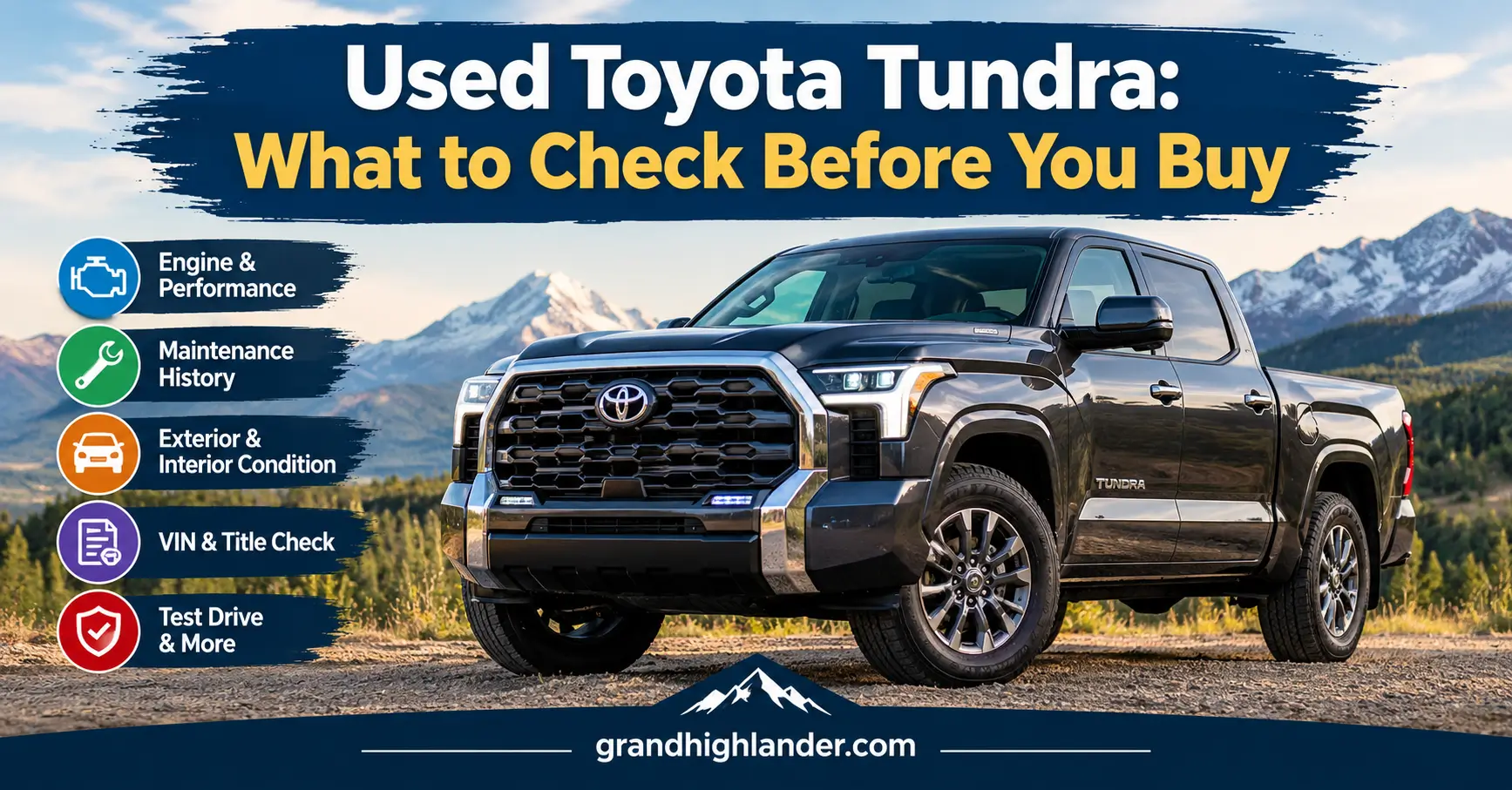
A used Toyota Tundra can make sense if you need a full-size pickup for towing, hauling, work, or everyday driving. But buying one is not as simple as choosing the lowest mileage or the cheapest listing. Two trucks from the same model year can be in very different condition, depending on how they were used, where they spent their lives, and whether previous owners kept up with maintenance.
Your budget also changes what you should expect. A Tundra priced below $10,000 may be an older truck with substantial mileage, while a newer model can cost several times as much. The important question is not just what the seller wants for it. It is what you will need to spend after the purchase.
Which Used Toyota Tundra Generation Should You Consider?
The Tundra has changed considerably over the years. Knowing which generation you are looking at helps you compare engines, features, age, and potential repair needs.
| Model years | What to know before buying |
|---|---|
| 2000–2006 | First-generation trucks. Age, rust, maintenance records, and previous work matter more than a low asking price alone. |
| 2007–2021 | Second-generation trucks, including the popular 5.7L V8. These can be worth considering, but condition varies widely between individual vehicles. |
| 2022 and newer | Third-generation trucks with a twin-turbocharged 3.4L V6, plus an available i-FORCE MAX hybrid powertrain. Expect a higher purchase price than for most older models. |
If you want a traditional V8, the 5.7L engine is available in many 2007–2021 Tundras. It produces 381 horsepower and 401 lb-ft of torque in the commonly cited configuration. The newer non-hybrid twin-turbo V6 produces up to 389 horsepower and 479 lb-ft, while the i-FORCE MAX hybrid produces up to 437 horsepower and 583 lb-ft.
Those figures help explain the differences between powertrains, but they do not tell you whether a particular used truck is a good buy. Service history and an independent inspection should influence your decision just as much as the engine badge.
How Much Does a Used Toyota Tundra Cost?
There is no single price that applies to every used Tundra. Model year, mileage, cab style, drivetrain, trim, accident history, and local market conditions all affect the asking price. Taxes, dealer fees, registration, and immediate repairs can add to the total.
Here is a useful way to think about common budget ranges:
- Under $10,000: Expect to look mainly at older, higher-mileage trucks. A low price may leave room in your budget for repairs, but only if you check the truck carefully before buying.
- Under $20,000: You may find more second-generation options, including some V8 models. Mileage and condition can still vary substantially.
- Newer and lower-mileage trucks: These generally require a larger budget. Later-model Limited and hybrid versions can sit in a very different price bracket from older SR5 trucks.
Listings reviewed for this guide illustrate those differences. One 2012 SR5 CrewMax 4WD with a 5.7L V8 was advertised at $9,995 with approximately 211,000 miles. Another listing showed a 2007 SR5 Double Cab 4WD with the 5.7L V8, around 151,000 miles, at $15,250. A 2023 Limited with roughly 45,500 miles was advertised at $40,590 before additional fees.
These are examples from individual listings, not current offers or reliable market averages. They also show why price alone can be misleading: the older truck with the lower asking price may need more maintenance, while the newer truck requires a much larger upfront investment.
Before making an offer, ask for an itemized out-the-door price and keep some money aside for maintenance or repairs.
Is a Used Toyota Tundra 4×4 Worth It?
A 4×4 Tundra is worth considering if you regularly drive on snow, loose gravel, rough work sites, or other surfaces where extra traction is useful. It may also suit buyers who need four-wheel drive for their work or outdoor activities.
However, 4×4 is not automatically the better purchase for everyone. If most of your driving takes place on paved roads and you do not need the extra capability, a rear-wheel-drive truck may meet your needs without making four-wheel-drive condition part of the inspection.
On a 4×4 model, check that the system engages and disengages as intended. Listen for unusual noises, watch for warning lights, and have the front differential, transfer case, and related components inspected. A seller saying that four-wheel drive works is not a substitute for testing it properly.
Double Cab, CrewMax, SR5, Limited, or TRD Pro?
The right version depends on how you plan to use the truck.
Double Cab: A reasonable option if you need rear seating but do not require the larger rear passenger area of the CrewMax. Check the exact bed length and seating layout because configurations vary.
CrewMax: Worth a look if you regularly carry adult passengers or want more rear-seat space. Confirm that the cab and bed combination suits your parking space and hauling needs.
SR5: Often a useful starting point for buyers who want a capable truck without paying for every premium feature. Equipment varies by model year, so check the actual vehicle rather than relying on the trim name alone.
Limited: Usually appeals to buyers looking for more comfort and convenience features. Compare the equipment and condition with similarly priced trucks before paying extra for the trim.
TRD Pro: Designed with off-road use in mind. If you are considering one, inspect the suspension, wheels, tires, underbody, and signs of hard off-road use. An off-road-oriented trim is not proof that the truck has been maintained well.
Used Toyota Tundra Problems to Check
No model year should be declared automatically good or bad without considering the specific vehicle and its maintenance history. Still, there are several areas worth checking during a used-Tundra inspection.
Oil and coolant leaks: Some V8 models can develop oil leaks, including around the cam towers, while coolant leaks can also occur. On a cold engine, look for visible leaks and ask the seller about any history of fluid loss or repairs. A clean engine bay does not prove that no leak exists.
Frame rust and underbody damage: This deserves special attention on older trucks, especially those used in regions where roads are salted in winter. Surface corrosion and serious structural rust are not the same thing. Have an independent mechanic assess the frame, suspension mounting points, and other structural areas.
Engine and transmission behaviour: Start the engine from cold if possible. Pay attention to unusual knocking, persistent warning lights, rough running, delayed engagement, or harsh shifts during the test drive. These symptoms need proper diagnosis rather than guesswork.
Suspension, steering, and brakes: Clunks over bumps, uneven tire wear, steering play, or vibration during braking can point to wear or previous damage. Repairs may be manageable, but they should be identified before you negotiate.
4WD system and service history: Check four-wheel-drive operation where fitted, and ask for records of relevant maintenance and repairs. On newer turbocharged or hybrid models, verify the vehicle’s service history and check for outstanding recalls using its VIN.
Some second-generation 5.7L V8 trucks have also been associated with secondary air-injection system faults. That does not mean every truck will develop the problem, but a warning light or stored fault code should be investigated before purchase.
Two Listing Details That Buyers Should Not Ignore
Consider the advertised 2012 SR5 CrewMax mentioned earlier: approximately 211,000 miles and a $9,995 asking price. The listing also described the truck as rust-free, while reporting rear-quarter-panel damage and information that needed closer verification.
That combination should prompt questions, not an automatic rejection or a quick purchase. Ask for the vehicle history, inspect the damaged area, and have the frame checked independently. Treat “rust-free” as a claim to verify, not as proof.
The 2007 SR5 Double Cab listing, advertised at $15,250 with around 151,000 miles, also illustrates an important point: an accident-history flag can matter even when a listing looks appealing. A clean title does not necessarily mean a vehicle has never been in an accident. Find out what happened, whether repairs were completed properly, and whether the damage affected structural components.
These examples are not recommendations to buy either truck. They show why reading the listing carefully and arranging an independent inspection can be more useful than comparing mileage and price alone.
Used Toyota Tundra Buying Checklist
Before agreeing to a purchase, work through these checks:
- Review the vehicle history. Look for accident records, title issues, ownership changes, and mileage inconsistencies.
- Ask for maintenance records. Receipts and dated service records are more useful than a general statement that the truck was regularly maintained.
- Inspect it from underneath. Check for structural rust, leaks, damaged components, and signs of poor repairs.
- Arrange a cold start and test drive. Pay attention to engine noise, transmission shifts, steering, brakes, and warning lights.
- Test the equipment. Check the 4WD system if fitted, air conditioning, electronics, cameras, and other features included with that truck.
- Get an independent pre-purchase inspection. Choose a mechanic who can inspect the vehicle on your behalf, rather than relying only on the seller’s assessment.
- Calculate the full cost. Include fees, insurance, immediate maintenance, tires, and any repairs identified during inspection.
If the seller refuses a reasonable inspection or will not explain important history details, be prepared to walk away. Another truck is usually preferable to an expensive surprise.
Related: Toyota Tundra
Conclusion
A used Toyota Tundra should be judged on more than its engine, trim, mileage, or advertised price. Check its history, inspect the frame and mechanical condition, verify the equipment, and calculate the costs you may face after purchase.
If your budget is tight, do not spend every dollar on the truck itself. Keeping money available for repairs and maintenance can make the difference between a sensible purchase and a costly mistake.
FAQs
Is a used Toyota Tundra reliable?
A well-maintained Tundra can be a sensible used-truck choice, but reliability depends on the model year, condition, maintenance, and how the truck was used. Check the individual vehicle rather than relying only on the brand’s reputation.
Which used Toyota Tundra years should I avoid?
There is no universal list that can replace a vehicle-specific inspection. Research the exact model year, engine, recalls, and known issues, then review the truck’s history and maintenance records before deciding.
Can I find a Toyota Tundra for sale under $10,000?
Older, high-mileage examples may appear in this price range. Budget for a thorough inspection and possible repairs, and do not assume that a low asking price represents the lowest total ownership cost.
Should I buy a used Toyota Tundra with over 150,000 miles?
Mileage alone is not enough to make that decision. A truck with documented maintenance and a clean inspection may be a better prospect than one with fewer miles but neglected servicing or hidden damage.
Is the 5.7L V8 a good choice?
It is worth considering if you specifically want a V8 Tundra. Check for leaks, warning lights, service history, and relevant engine-system issues. The condition of the individual truck matters more than choosing the engine based on reputation alone.
Is CrewMax better than Double Cab?
CrewMax offers more rear passenger space, while Double Cab may suit buyers who do not need as much room. Compare the actual cab and bed configuration against how you will use the truck.
Should I buy a used Tundra Limited or SR5?
Choose based on the equipment you need, the condition of the vehicle, and the price difference. A well-maintained SR5 may be a better purchase than a neglected Limited with more features.







Leave a Reply