
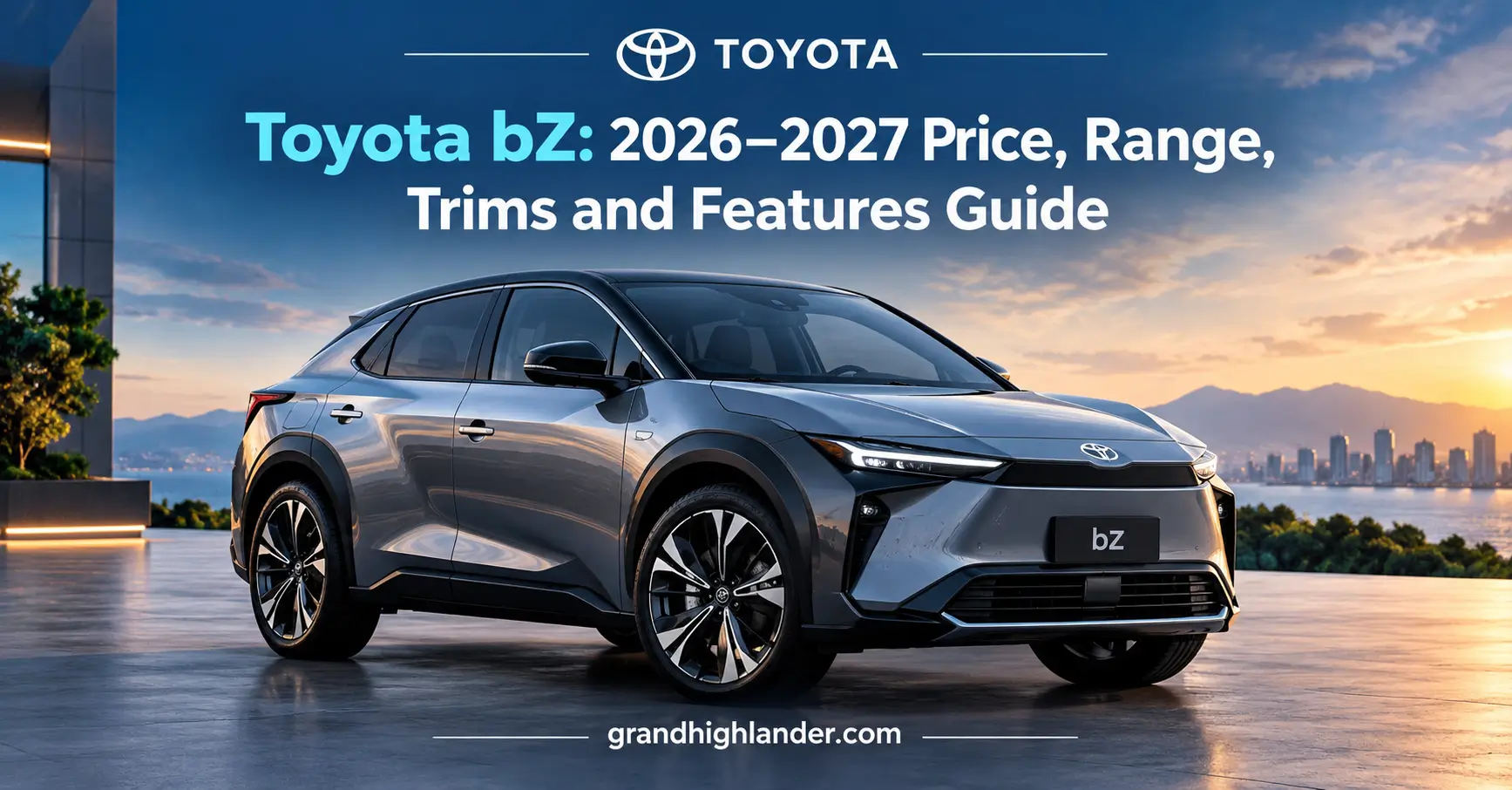
The Toyota bZ is an all-electric compact SUV designed for drivers who want to switch to electric driving without giving up everyday practicality. Its updated battery options, improved power, modern cabin technology and compatibility with different charging networks make it more capable than the earlier bZ4X. However, choosing the right version requires more than looking at its maximum driving range.
The Toyota bZ lineup offers different battery capacities, front-wheel drive and all-wheel drive configurations, and a noticeable gap between entry-level and premium models. This guide explains the price differences, estimated range, charging capabilities, interior features and limitations buyers should understand before choosing a 2026 or 2027 Toyota bZ.
What Is the Toyota bZ?
The Toyota bZ is a battery-electric SUV that runs entirely on electricity. In the US market, Toyota dropped the bZ4X name from the vehicle for the 2026 model year and introduced a substantial update to its battery, powertrain and interior technology.
Unlike a conventional gasoline SUV, the bZ does not have a gasoline engine. It also does not need gasoline as a backup power source, so owners must plan their journeys around battery range and charging access.
The SUV uses Toyota’s e-TNGA electric vehicle platform. Its main appeal is straightforward: familiar SUV practicality combined with electric driving, quiet operation and fewer routine powertrain maintenance requirements than a comparable gasoline vehicle.
Toyota bZ Price: 2026 vs. 2027
Pricing depends on the model year, trim, drivetrain and selected equipment. The 2026 and 2027 figures should not be treated as interchangeable.
| Model year and trim | Listed starting price |
|---|---|
| 2026 XLE FWD | $36,495 |
| 2026 XLE FWD Plus | $39,495 |
| 2026 XLE AWD | $41,495 |
| 2026 Limited FWD | $44,895 |
| 2026 Limited AWD | $46,895 |
| 2027 XLE FWD | $34,980 |
| 2027 XLE FWD Plus | $37,980 |
| 2027 Limited FWD | $43,380 |
These are US-market prices before applicable taxes, registration, dealer charges and optional equipment. The 2027 figures for the XLE FWD Plus and Limited FWD correspond to those specific configurations, not the entry-level model.
For buyers comparing prices, the cheapest version may not be the best value. A higher-output motor, larger battery or all-wheel drive can change both the purchase price and the vehicle’s driving characteristics. Check the exact trim and equipment before comparing two listings.
Toyota bZ Range and Battery Options
Driving range is one of the most important factors when choosing an electric SUV. The 2026 Toyota bZ offers two battery capacities: a 57.7-kWh battery for the entry-level XLE FWD and a larger 74.7-kWh battery for other configurations.
The 2027 lineup offers the following EPA-estimated ranges by configuration:
| 2027 Toyota bZ configuration | Estimated range |
|---|---|
| XLE FWD | 236 miles |
| XLE FWD Plus | 314 miles |
| XLE AWD | 288 miles |
| Limited FWD | 299 miles |
| Limited AWD | 278 miles |
The XLE FWD Plus has the longest listed range, while the standard XLE FWD is aimed at buyers whose daily driving needs do not require the larger battery. All-wheel drive provides additional traction and power, but its estimated range is lower than that of the longest-range front-wheel-drive model.
These figures are estimates, not guaranteed distances. Highway speeds, cold weather, heating or air conditioning, passenger load, tire pressure and driving style can all reduce the distance available between charges.
Think about your regular commute before paying extra for a longer-range model. Someone who drives short distances and charges at home may have different priorities from someone who regularly travels between cities.
Toyota bZ Performance: FWD vs. AWD
The Toyota bZ is available with front-wheel drive and dual-motor all-wheel drive, depending on trim.
The entry-level 2026 XLE FWD produces 168 horsepower. The XLE FWD Plus and Limited FWD use a more powerful single-motor setup producing 221 horsepower. The AWD versions deliver a combined 338 horsepower.
For everyday commuting, the front-wheel-drive versions should provide sufficient power for normal traffic and routine journeys. The higher-output configuration offers stronger acceleration, while AWD can provide additional traction on slippery roads.
However, AWD is not automatically the better choice for every buyer. It generally costs more, and its estimated range is lower than the longest-range FWD version. Consider your climate, road conditions and driving habits rather than choosing solely by horsepower.
Charging the Toyota bZ
The updated Toyota bZ supports several improvements over earlier versions, including an 11-kW onboard AC charger, a standard North American Charging System (NACS) port and battery preconditioning.
NACS compatibility allows the vehicle to use compatible charging stations, including participating Tesla Supercharger locations where access is available. Adapters are also provided for compatibility with J1772 and CCS charging equipment.
Toyota quotes a charging time of approximately 30 minutes to charge the battery from 10% to 80% under suitable DC fast-charging conditions. The maximum DC fast-charging rate is listed at 150 kW.
That does not mean every charging stop will take exactly 30 minutes. Battery temperature, charger output, charging-station availability and the battery’s current charge level all affect the result. Cold weather can be particularly important, which is why battery preconditioning is useful before a fast-charging stop.
For home charging, the 11-kW onboard charger is relevant when the electrical supply and charging equipment can support that rate. Actual charging speed may be lower with a less powerful home charger.
Toyota bZ Interior and Technology
The updated cabin includes a 14-inch multimedia touchscreen, wireless Apple CarPlay and Android Auto, two wireless phone-charging pads and four USB-C ports. A 7-inch digital instrument display provides driving information.
Heated front seats and a heated steering wheel are included across the described 2026 lineup. Equipment such as ventilated front seats, heated rear seats, a digital rearview mirror and additional driver-assistance features depends on trim.
The cabin has useful technology, but its layout may not suit everyone. The high-mounted driver display sits in an unusual position above the steering wheel, so buyers should check visibility and seating comfort during a test drive.
Cargo space is another consideration. The 2026 bZ provides approximately 27.7 cubic feet behind the rear seats and 56.9 cubic feet with the rear seats folded. That is useful for everyday shopping and luggage, although some competing electric SUVs offer more total cargo capacity.
Safety Features and Driver Assistance
The Toyota bZ includes Toyota Safety Sense 3.0, with features such as lane departure warning, lane-keeping assistance, adaptive cruise control and automatic emergency braking. Blind-spot monitoring and rear cross-traffic alerts are also part of its safety and driver-assistance equipment.
Certain advanced features, including a 360-degree camera, traffic-jam assistance, lane-change assistance and automated parking assistance, depend on the trim and equipment.
These systems can support the driver, but they do not replace attention or control. Buyers should confirm which features are standard on the exact vehicle they are considering rather than assuming every bZ includes the same equipment.
Related: Toyota bZ4X Review: Is This Electric SUV Worth Buying in 2026?
Conclusion
The Toyota bZ makes the most sense for drivers who want an electric SUV with modern connectivity, useful everyday cargo space and a choice of range and performance configurations.
Its main strengths are the available 314-mile estimated range, improved charging hardware, strong AWD output and a substantial standard technology package. The trade-offs include charging performance that is not class-leading, an unusual instrument-display layout and less cargo space than some rivals.
Before buying, consider three practical questions: Can you charge at home or work? Is the available range sufficient for your longest regular journeys? And does the price of your preferred trim justify its additional features?
If you have convenient charging and mostly predictable daily driving, the bZ may be a sensible electric SUV. If you frequently take long highway trips in cold weather, compare its charging stops and available range with other electric vehicles before making a decision.
FAQs
Is the Toyota bZ fully electric?
Yes. The Toyota bZ is a battery-electric SUV. It does not use a gasoline engine, and it must be charged using compatible electrical charging equipment.
How much does the 2026 Toyota bZ cost?
The listed US starting price for the 2026 lineup begins at $36,495 for the XLE FWD and reaches $46,895 for the Limited AWD. Equipment, taxes and dealer charges can affect the final purchase price.
What is the 2027 Toyota bZ’s maximum range?
The 2027 XLE FWD Plus has an EPA-estimated range of up to 314 miles. Other versions have different estimates depending on battery, drivetrain and trim.
Is the Toyota bZ available with all-wheel drive?
Yes. Selected XLE and Limited configurations offer dual-motor AWD with a combined output of 338 horsepower in the 2026 lineup. Availability and specifications should be checked for the exact model year.
How long does it take to charge the Toyota bZ?
A DC fast-charging session from 10% to 80% is quoted at approximately 30 minutes under suitable conditions. Actual time varies with the charger, battery temperature and other factors.
Does the Toyota bZ have a hybrid version?
The Toyota bZ discussed in this guide is fully electric, not a hybrid. It does not combine a gasoline engine with an electric motor.
Is the Toyota bZ the same as the bZ4X?
The US-market model was called the bZ4X before the 2026 model year. For 2026, Toyota adopted the shorter bZ name and introduced significant updates to the vehicle.
Is the Toyota bZ a good choice for long-distance driving?
It can handle longer journeys, particularly in a longer-range configuration, but trip planning matters. Drivers should consider charging-station access, highway energy use, weather and the time needed for charging stops.
Is the Toyota bZ made by a Chinese automaker?
No. The Toyota bZ is a Toyota-branded electric vehicle. Its name does not indicate that it is a Chinese automotive brand.
Should I choose the XLE FWD Plus or Limited FWD?
The XLE FWD Plus is worth considering if maximum estimated range and value are priorities. The Limited FWD adds premium equipment and has a listed range of 299 miles. Compare the exact features and prices before deciding.






Leave a Reply