
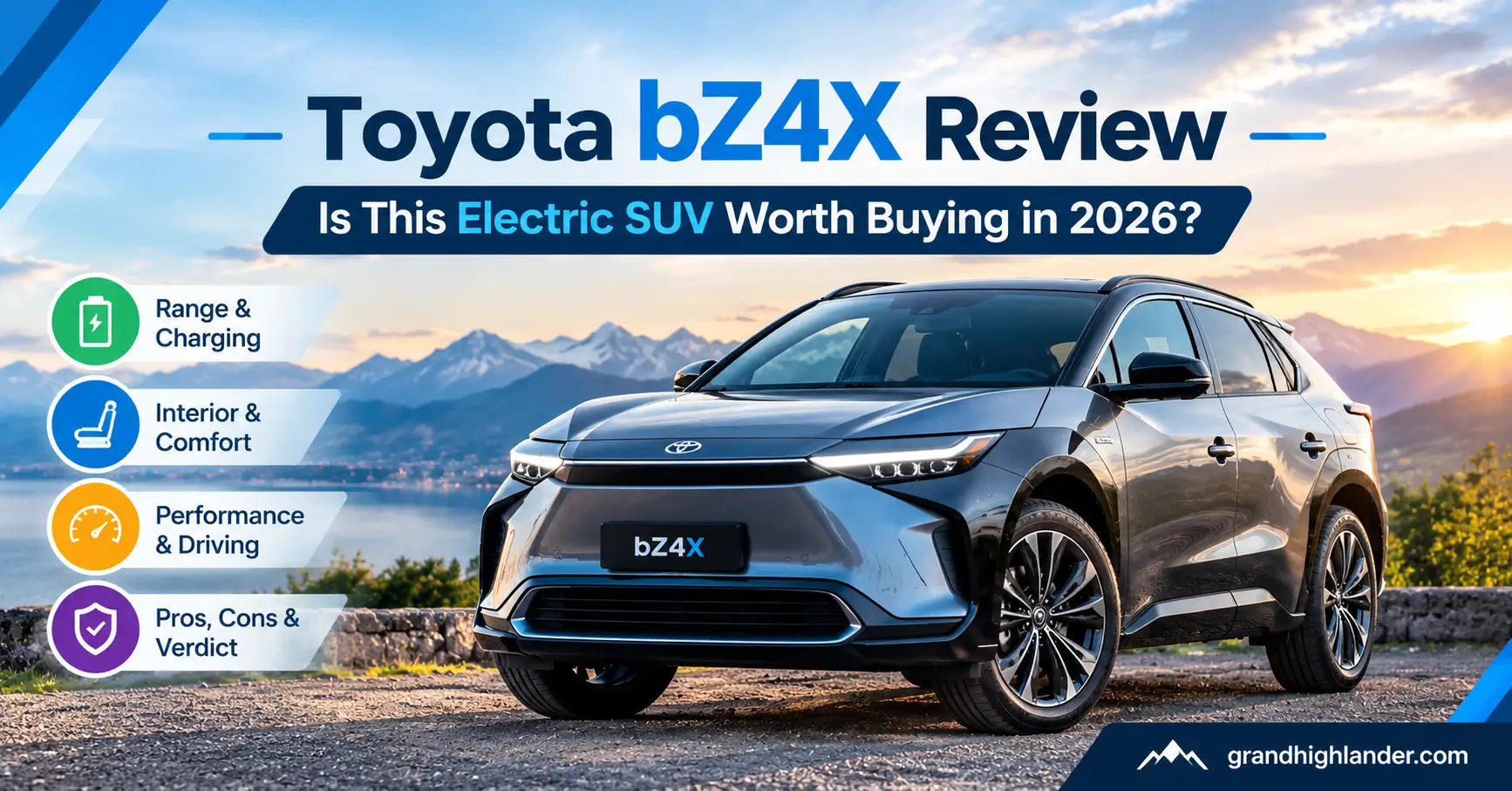
The 2026 Toyota bZ4X is an all-electric family SUV with a longer potential driving range, updated technology and improved powertrain performance compared with the original model. It offers a comfortable cabin, useful passenger space and a choice of front-wheel drive or all-wheel drive. However, its boot capacity, interior storage and real-world efficiency deserve careful consideration before you buy.
So, is the Toyota bZ4X worth buying in 2026? It could be a sensible choice for drivers who want an electric SUV from an established manufacturer, especially if home charging is available. The best version for you will depend on your budget, daily mileage and how often you take longer journeys.
Quick Verdict: Toyota bZ4X at a Glance
- Best for: Daily commuting, family journeys and drivers with access to home charging.
- Biggest strengths: Comfortable ride, spacious rear seating, updated technology and a claimed range of up to 352 miles.
- Main drawbacks: A 452-litre boot, limited cabin storage and range that can fall in cold weather or at motorway speeds.
- Best range-focused option: The 73.1kWh Design front-wheel-drive model.
- Final verdict: A much-improved electric SUV that makes sense for the right driver, but buyers should compare its practicality and efficiency with other EVs before committing.
2026 Toyota bZ4X Price and Specifications
The 2026 bZ4X range introduces revised battery options and electric motors, alongside a redesigned cabin and upgraded equipment. UK prices depend on the trim level, drivetrain and options selected. The following specifications refer to the standard UK-market SUV, not the separate bZ4X Touring model.
| Specification | Toyota bZ4X (2026 UK model) |
|---|---|
| Vehicle type | Fully electric midsize SUV |
| Seating capacity | 5 |
| Battery options | 57.7kWh and 73.1kWh |
| Maximum claimed WLTP range | Up to 352 miles |
| Maximum DC charging power | Up to 150kW |
| Approximate 10–80% DC charging time | Around 28 minutes under suitable conditions |
| Maximum power | Up to 338bhp, depending on version |
| Boot capacity | 452 litres |
| Drive options | Front-wheel drive and all-wheel drive |
| Starting price | Around £40,000 before applicable offers |
Specifications and range vary by trim and wheel size. WLTP figures are laboratory-based comparison figures rather than guaranteed everyday results.
Design and Interior: Comfortable, Modern and Practical
The refreshed bZ4X has a cleaner exterior design, with a more distinctive front end and updated detailing. Its styling is recognisably SUV-like without being excessively aggressive. The overall shape prioritises family usability and everyday driving rather than a sporty appearance.
Inside, the redesigned dashboard and standard 14-inch multimedia display give the 2026 model a more contemporary feel. Wireless Apple CarPlay, twin wireless phone chargers and ambient cabin lighting add useful convenience. Exact equipment can vary by trim and market.
Passenger Space and Comfort
Rear legroom is one of the bZ4X’s stronger points. Adults can sit comfortably in the back, making the vehicle suitable for families and regular passenger journeys. The quiet electric powertrain and comfort-focused suspension also help make everyday trips more relaxed.
There are some cabin compromises. The driving position and steering-wheel adjustment may take time to get right, and the driver’s display can be awkward to see for some seating positions. Storage is another weakness: the cabin lacks a conventional glovebox, so smaller everyday items may not have an obvious place.
Overall, the bZ4X prioritises passenger comfort, although its cabin layout is not perfect.
Toyota bZ4X Range: How Far Can It Travel?
Driving range is a major consideration when choosing an electric SUV. The 2026 bZ4X offers two battery sizes, allowing buyers to choose between a lower-cost entry model and a longer-range version.
The smaller 57.7kWh battery has a claimed WLTP range of approximately 274 miles. The larger 73.1kWh battery can deliver up to 352 miles in the front-wheel-drive Design trim with 18-inch wheels. Higher-specification versions with larger wheels or all-wheel drive have lower official figures.
Real-world range depends on several factors, including:
- Cold weather and battery temperature.
- Motorway speeds and driving style.
- Heating or air-conditioning use.
- Wheel size, load and road conditions.
For daily commuting, school runs and local errands, the bZ4X should offer useful range without requiring frequent public charging if the vehicle is charged regularly at home. Drivers who cover long motorway distances should leave a margin for weather-related range reductions and charging stops.
Charging: Convenient for Some, Less So for Others
The bZ4X supports DC rapid charging at up to 150kW. Under suitable conditions, charging from 10% to 80% can take around 28 minutes, although actual times depend on battery temperature, charger performance and the vehicle’s state of charge.
Battery preconditioning helps prepare the battery for rapid charging when conditions and navigation settings support it. The feature can improve charging performance, but it does not eliminate every delay.
AC charging is also available for home or workplace use. The standard onboard charger and the higher-capacity 22kW option vary by grade, so check the specification of the exact vehicle before buying.
Home charging is a significant advantage. You can replenish the battery overnight and begin most days with enough range for routine driving. Without home or workplace charging, relying entirely on public chargers may be less convenient and can make running costs less predictable.
Driving Experience and Performance
The bZ4X is designed primarily for comfortable, everyday driving. Its electric motor delivers smooth acceleration, while the updated suspension aims to improve ride comfort and body control.
Front-wheel-drive models should suit most drivers who mainly use paved roads and urban or suburban routes. The all-wheel-drive Excel is more powerful and accelerates from 0–62mph in approximately 5.1 seconds, making it the stronger choice for drivers who prioritise performance or want additional traction.
However, the bZ4X is not intended to be a dedicated sports SUV. Steering feedback is relatively restrained, and buyers seeking the most engaging driving experience may prefer to compare alternatives. Regenerative braking helps recover energy during deceleration, but the driving experience may not feel identical to an EV with a strong one-pedal mode.
For most family buyers, its smooth power delivery and comfortable character are likely to matter more than outright speed.
Boot Space and Everyday Practicality
The standard Toyota bZ4X has a 452-litre boot. That is useful for weekly shopping, school bags and ordinary family luggage, but some rival electric SUVs offer more cargo capacity.
The rear seats fold to accommodate longer items, adding flexibility when you need to carry bulky loads. Even so, the boot’s shape and available space should be checked in person if you regularly carry a pushchair, large suitcases, sports equipment or bulky shopping.
There is no front storage compartment, or frunk, for extra luggage. The lack of a glovebox also limits convenient storage for smaller items. These details do not make the bZ4X impractical, but they are worth considering if you want your next family car to maximise storage.
Who Should Buy the 2026 bZ4X (and Who Should Avoid It)?
The bZ4X could suit you if:
- You commute daily: The electric drivetrain is well suited to predictable daily journeys, especially with overnight home charging.
- You want a comfortable family SUV: The spacious rear seating and quiet cabin support regular family use.
- You prefer front-wheel drive: The range-focused Design version offers the highest claimed range in the standard UK line-up.
- You want an established brand: Toyota’s service network and available service-activated warranty arrangements may provide additional reassurance, subject to their terms.
You may want to consider another vehicle if:
- You frequently take long motorway trips: High speeds and cold weather can reduce range and increase charging stops.
- You need maximum luggage space: The 452-litre boot and lack of a frunk may be limiting for larger families.
- You cannot charge at home or work: Public charging may require more planning and could affect the cost and convenience of ownership.
- You want the lowest purchase price or best efficiency: Compare the bZ4X’s total cost and energy consumption with other electric SUVs before deciding.
Toyota bZ4X Pros and Cons
Pros
- Comfortable ride for everyday journeys.
- Good rear legroom for adult passengers.
- Updated 14-inch multimedia system.
- Claimed range of up to 352 miles on the right version.
- Front-wheel-drive and all-wheel-drive options.
- Smooth electric acceleration and quiet running.
Cons
- Boot capacity is modest compared with some alternatives.
- No frunk or conventional glovebox.
- Actual range can drop in cold weather and at motorway speeds.
- Rapid charging depends on battery and charger conditions.
- Driver display visibility and cabin storage may frustrate some users.
Toyota bZ4X vs Toyota RAV4: Which Is Better?
The main difference is the powertrain. The bZ4X is fully electric, while the RAV4 is offered with hybrid or plug-in hybrid powertrains in selected markets.
Choose the bZ4X if you have reliable access to charging, want to drive without petrol during normal use and can plan longer journeys around charging stops.
Choose the RAV4 if you want the flexibility of a petrol-hybrid vehicle or regularly travel where charging infrastructure is limited. A plug-in hybrid RAV4 may offer electric-only driving for some journeys, but it still has a petrol engine.
Neither is automatically better for everyone. Your home-charging situation, annual mileage, journey patterns and purchase budget should guide the decision.
Related: 2026 Toyota RAV4 guide
Conclusion
The 2026 Toyota bZ4X is a more convincing electric SUV than its original version. Its updated powertrain, improved range figures, modernised cabin and comfortable driving character make it a credible option for everyday family transport.
Its weaknesses are still important. The boot is not class-leading, cabin storage is limited, and the official range should not be treated as a guarantee for every journey. Drivers who regularly travel long distances or depend on public charging should think carefully about how the car fits their routine.
For buyers with home charging who want a comfortable, practical electric SUV, the bZ4X deserves consideration. The larger-battery, front-wheel-drive Design model is particularly appealing if range is the priority. Before purchasing, compare the exact trim’s price, equipment, charging specification and expected range with your own driving needs.
FAQs
1. Is the Toyota bZ4X worth buying?
Yes, it can be worth buying if you want a comfortable electric SUV and have convenient charging access. Its value depends on the trim price, your driving habits and the alternatives available to you.
2. What is the range of the 2026 Toyota bZ4X?
The UK model has a claimed WLTP range of approximately 274 miles with the smaller battery and up to 352 miles with the larger battery in the Design front-wheel-drive version. Other trims have lower figures.
3. How long does the Toyota bZ4X take to charge?
A compatible rapid charger can charge the battery from 10% to 80% in around 28 minutes under suitable conditions. Temperature, charger output and battery state affect the actual time.
4. What are the main disadvantages of the Toyota bZ4X?
Its main drawbacks include a 452-litre boot, limited cabin storage, no frunk and a range that can decrease in cold weather or at motorway speeds.
5. Is the Toyota bZ4X good for long-distance driving?
It can handle long journeys, but drivers need to plan charging stops and allow for changing weather and road conditions. Frequent motorway travellers should compare its charging experience and efficiency with other EVs.
6. Does the Toyota bZ4X have all-wheel drive?
Yes. The UK range includes an all-wheel-drive version of the 73.1kWh Excel. Front-wheel-drive versions are also available.
7. Does the Toyota bZ4X have a large boot?
It offers 452 litres of boot space, which is suitable for many everyday needs but smaller than the cargo areas found in some competing SUVs. There is no front boot.
8. Is the Toyota bZ4X better than the RAV4?
The bZ4X is a better fit for drivers who want a fully electric vehicle and can charge regularly. The RAV4 may suit drivers who prefer hybrid power or need greater flexibility on journeys without convenient charging.
9. Is the 2026 Toyota bZ4X different from the original model?
Yes. The updated model brings revised battery and motor options, a redesigned dashboard, a 14-inch multimedia display and changes intended to improve efficiency, performance and ride comfort.
10. Which 2026 Toyota bZ4X version offers the longest range?
The UK-market 73.1kWh Design front-wheel-drive version has the highest claimed WLTP range, at up to 352 miles with the specified 18-inch wheels.







Leave a Reply