
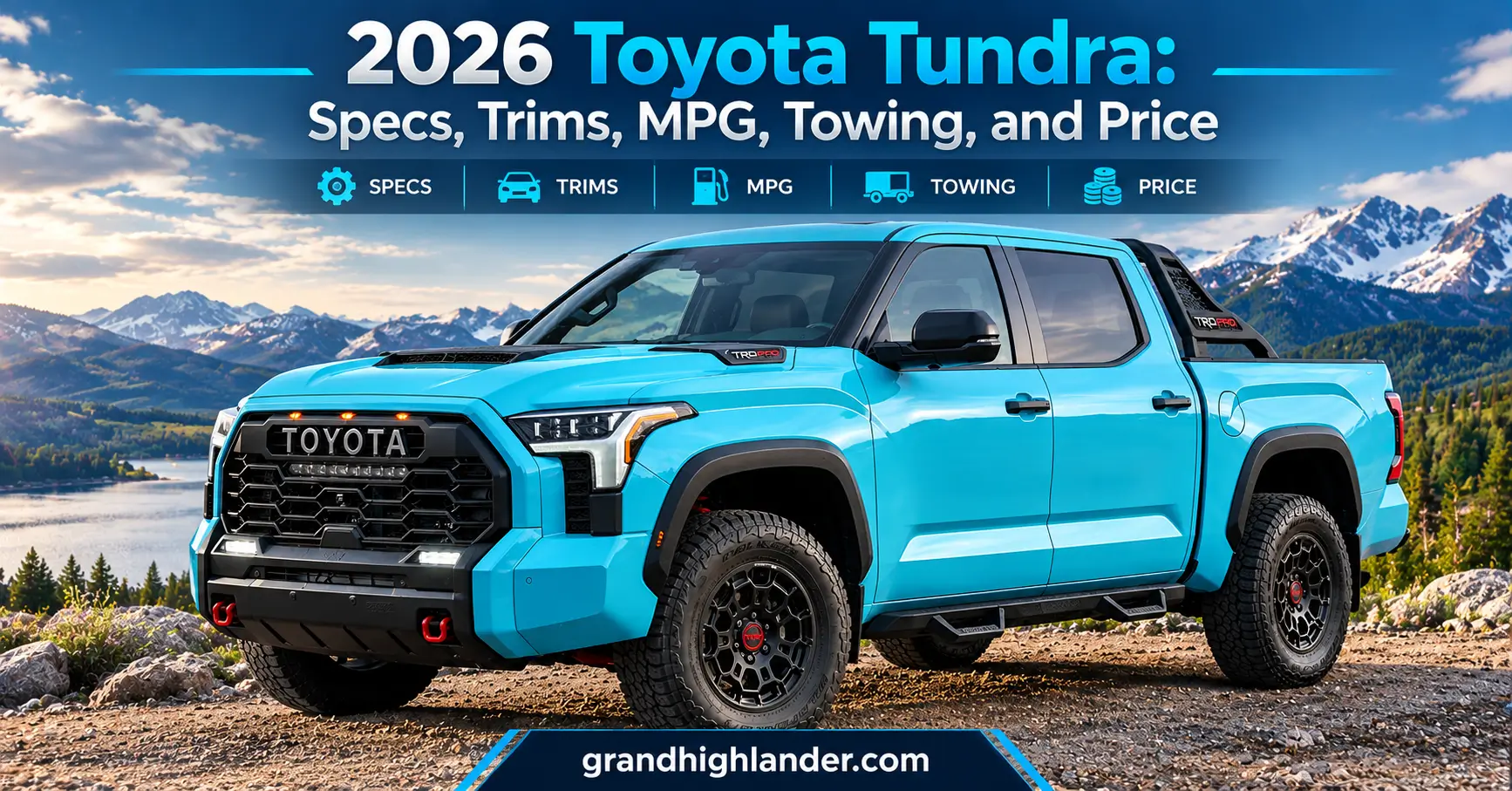
The 2026 Toyota Tundra brings together twin-turbo V6 power, an available hybrid powertrain, practical truck capability, and a range of comfort and off-road features. But is the latest Tundra the right full-size pickup for your needs? And do its new features make it worth choosing over an earlier model?
For 2026, Toyota has made several targeted updates rather than completely redesigning the truck. Every model now comes with a larger 32.2-gallon fuel tank and a standard tow hitch with a 7/4-pin trailer connector. The lineup also gains interior refinements, while the TRD Pro receives a striking new exterior color.
This guide covers the 2026 Toyota Tundra’s engines, trim levels, fuel economy, towing capacity, interior technology, safety features, and pricing considerations to help you understand what matters before buying.
What Is New for the 2026 Toyota Tundra?
The 2026 Toyota Tundra focuses on useful equipment changes and selected styling improvements. Here are the main updates buyers should know about.
- Larger fuel tank: A 32.2-gallon fuel tank is now standard across the lineup.
- Standard towing equipment: Every grade, including the entry-level SR, receives a tow hitch and 7/4-pin connector.
- Updated Capstone interior: The premium trim adds Shale Premium Textured leather-trimmed seating.
- Revised Limited seating: Leather-trimmed seats become standard, with updated black and gray interior treatments.
- New TRD Pro color: Wave Maker introduces a distinctive blue finish exclusive to the TRD Pro.
- Optional off-road seating: ISO Dynamic seats become available on the TRD Pro.
- Improved rear passenger comfort: Double Cab models receive rear center-console air vents.
- Additional package changes: The TRD Rally Package gains availability for a TRD 3-inch lift kit and Tow Tech Package.
These updates improve convenience and personalization, but they do not mean every Tundra receives every premium feature. Availability depends on the trim and selected equipment.
2026 Toyota Tundra Price
The 2026 Toyota Tundra is offered in several configurations, from a work-focused base truck to premium and off-road models. In the U.S. market, the published starting MSRP for the SR is $41,260, before applicable destination charges, taxes, dealer fees, and optional equipment.
Prices increase with higher trim levels, four-wheel drive, hybrid equipment, and additional packages. The final amount also depends on the specific configuration and local inventory.
Before comparing prices, check whether the advertised figure includes destination charges and whether it applies to a gas-powered or hybrid model.
Is the most expensive Tundra automatically the best choice? Not necessarily. A work-truck buyer may value payload, bed length, and towing equipment more than premium upholstery. Someone who spends long hours on the road may prioritise cabin comfort and infotainment, while an off-road enthusiast may prefer the TRD Pro.
U.S. MSRP should not be treated as a price for Pakistan or another international market. Import duties, taxes, shipping, exchange rates, and local availability can substantially affect the final cost.
2026 Toyota Tundra Engine Options and Performance
The 2026 Toyota Tundra uses a 3.4-liter-class twin-turbocharged V6 rather than a traditional V8. Buyers can choose between the i-FORCE gasoline powertrain and the available i-FORCE MAX hybrid system.
i-FORCE Twin-Turbo V6
The standard i-FORCE engine produces up to 389 horsepower and 479 lb-ft of torque in applicable configurations. The entry-level SR uses a lower-output version, rated at 348 horsepower.
A 10-speed automatic transmission manages power delivery. Depending on the configuration, the truck is available with rear-wheel drive or four-wheel drive.
This powertrain is worth considering if you want strong acceleration and useful truck capability without opting for the hybrid system.
i-FORCE MAX Hybrid Powertrain
The i-FORCE MAX combines the twin-turbo V6 with an electric motor integrated into the powertrain. It produces 437 net combined horsepower and 583 lb-ft of torque.
The electric motor contributes additional pulling force and helps deliver strong response under acceleration. This setup is available on selected trims and is standard on the TRD Pro and Capstone.
However, hybrid power does not automatically mean dramatically lower fuel consumption. The truck’s weight, tires, drivetrain, driving style, and intended use all affect efficiency.
Which Engine Should You Choose?
The gasoline engine makes sense for buyers who want the standard powertrain and do not need the hybrid’s additional output. The i-FORCE MAX is worth considering if you value stronger performance and want a truck equipped with the hybrid system.
Compare the price difference, fuel-economy ratings, available equipment, and your expected annual mileage before deciding.
2026 Toyota Tundra Trim Levels
The Tundra lineup covers practical, premium, and off-road-focused needs. Exact equipment varies by configuration.
Tundra SR
The SR is the entry-level model and is suited to buyers who prioritize essential truck functionality. It includes the 3.4-liter twin-turbo V6 in its lower-output configuration, an 8-inch multimedia touchscreen, and an aluminum-reinforced composite bed.
It is worth considering for basic work duties and buyers who do not need extensive luxury features.
Tundra SR5
The SR5 adds equipment that can make the truck more versatile for everyday driving and towing. Features include alloy wheels, selectable driving modes, and additional available packages.
For buyers who need a balance between capability and comfort, this trim deserves a close look.
Tundra Limited
The Limited brings more convenience and premium equipment, including a 14-inch multimedia touchscreen and leather-trimmed seating. Selected configurations are also available with the i-FORCE MAX hybrid system.
It may suit drivers who use their pickup for commuting, family travel, and recreational towing.
Tundra Platinum
The Platinum emphasizes comfort and upscale features. Depending on configuration, it offers premium seating, a panoramic roof, and additional convenience equipment.
It is aimed at buyers who want a more luxurious cabin without choosing the most expensive trim.
Tundra 1794 Edition
The 1794 Edition combines premium equipment with distinctive styling. Its available interior treatments include Saddle Tan seating and American walnut wood-grain trim.
It is an option for buyers who want a more traditional luxury-truck appearance.
Tundra TRD Pro
The TRD Pro is designed for off-road use and comes standard with the i-FORCE MAX hybrid powertrain and four-wheel drive. Its equipment includes specialized suspension components, off-road tires, an electronically locking rear differential, and trail-oriented driving systems.
For 2026, the exclusive Wave Maker color adds another way to distinguish this model.
Tundra Capstone
The Capstone sits at the luxury end of the lineup. Its premium interior receives updated Shale leather-trimmed seating for 2026, along with upscale comfort and convenience features.
Buyers should compare its equipment with the Platinum and 1794 Edition before paying more for the top-tier trim.
2026 Toyota Tundra MPG and Fuel Economy
Fuel economy is an important consideration when buying a full-size pickup, particularly if you drive long distances or tow regularly.
Official estimated fuel economy varies by powertrain, drivetrain, and trim. For example, many gasoline-powered configurations are rated at approximately 18 mpg city and 23 mpg highway with rear-wheel drive, while four-wheel-drive versions generally receive lower ratings. Hybrid ratings vary, and the TRD Pro has its own fuel-economy figures.
These are U.S. EPA estimates, not guaranteed real-world results.
Actual MPG can change considerably with traffic, speed, temperature, cargo, tire choice, towing, and acceleration. A truck that performs well on a steady highway trip may use much more fuel during stop-and-go driving or while pulling a heavy trailer.
Does the Larger Fuel Tank Improve Driving Range?
The standard 32.2-gallon tank gives every 2026 Tundra a larger fuel capacity than the smaller tank previously offered on some configurations. That can reduce how frequently you need to refuel.
However, a larger tank does not improve the engine’s MPG rating. It increases the amount of fuel the truck can carry, while the actual distance between stops still depends on fuel consumption and driving conditions.
For a realistic ownership estimate, consider your usual driving pattern rather than relying solely on the highest published MPG figure.
2026 Toyota Tundra Towing Capacity and Payload
The 2026 Toyota Tundra offers a maximum towing capacity of up to 12,000 pounds when properly equipped. The exact rating depends on the engine, drivetrain, cab, bed, axle configuration, and installed equipment.
The advertised maximum should not be assumed to apply to every trim.
Payload is a separate measurement. It represents how much weight the truck can carry, including occupants, cargo, accessories, and applicable trailer tongue weight. A truck can have substantial towing capability while still having a more limited payload allowance.
Before towing a trailer, check the specific vehicle’s door-jamb payload label, owner’s manual, and applicable towing limits. Account for the trailer’s loaded weight, tongue weight, passengers, and cargo.
Is 12,000 Pounds Enough for Your Trailer?
For many recreational trailers, boats, and general hauling needs, that maximum rating may be sufficient. But choosing a truck based only on the headline towing figure can be misleading.
A trailer that falls below the maximum towing rating can still exceed payload or other vehicle limits once passengers, equipment, and tongue weight are included. The correct configuration matters more than the biggest number in an advertisement.
Interior, Comfort, and Technology
The 2026 Toyota Tundra combines a functional truck cabin with available premium materials and modern infotainment.
An 8-inch touchscreen is standard on the SR, while a 14-inch touchscreen is available on selected higher trims. The system supports wireless Apple CarPlay and Android Auto, allowing compatible phones to connect without a cable.
A 12.3-inch digital instrument display is available on selected configurations. Depending on trim and options, buyers can also get premium audio, wireless charging, heated or ventilated seating, and additional comfort features.
The Double Cab and CrewMax layouts serve different needs. Buyers who regularly carry adults in the rear seats should compare rear-seat space and access before choosing a cab configuration.
The composite cargo bed is designed to resist dents, impacts, and rust. Available bed lengths include approximately 5.5 feet, 6.5 feet, and 8.1 feet, depending on the configuration.
Which interior feature is worth paying extra for? That depends on how you use the truck. A larger screen may be useful for navigation and daily driving, while premium seating can matter more on long journeys. If you regularly transport tools or outdoor equipment, bed size and storage may deserve higher priority.
Off-Road Capability: What Makes the TRD Pro Different?
The Tundra TRD Pro is the lineup’s dedicated off-road-focused model. Its equipment is designed to help manage uneven surfaces, loose terrain, and trail obstacles.
Available off-road technologies across applicable models include Multi-Terrain Select, Crawl Control, Downhill Assist Control, and a Multi-Terrain Monitor. The TRD Pro also receives specialized suspension hardware, four-wheel drive, and an electronically locking rear differential.
These systems can help the driver manage traction and low-speed movement, but they do not remove the need for careful driving. Ground clearance, tire condition, approach angles, terrain, and driver judgment remain important.
The TRD Pro’s Wave Maker color is exclusive to the 2026 model year lineup’s TRD Pro offering. Buyers should confirm availability when ordering because colors and equipment can vary with production and inventory.
If your driving is mostly on paved roads, the additional off-road equipment may be unnecessary. If you regularly travel on rough trails, it may provide benefits that a standard trim cannot match.
Safety and Driver-Assistance Features
The 2026 Toyota Tundra includes Toyota Safety Sense 2.5. Its driver-assistance features are designed to support the driver, not replace attention or responsible driving.
Depending on the system and configuration, the package includes features such as:
- Pre-Collision System with Pedestrian Detection
- Dynamic Radar Cruise Control
- Lane Departure Alert
- Lane Tracing Assist
- Automatic High Beams
- Road Sign Assist
Additional features, including Blind Spot Monitor, Rear Cross-Traffic Alert, and parking assistance, vary by trim and equipment.
Drivers should read the owner’s manual to understand system limitations. Weather, road markings, visibility, traffic, and other conditions can affect how driver-assistance technologies operate.
Warranty and Ownership Considerations
For U.S. models, Toyota lists a basic new-vehicle warranty of 36 months or 36,000 miles and a powertrain warranty of 60 months or 60,000 miles, subject to the applicable warranty terms.
ToyotaCare provides scheduled maintenance and roadside assistance for two years or 25,000 miles, whichever comes first, under the stated U.S. program terms.
Warranty coverage and included services can differ outside the United States. Imported vehicles may also have different support arrangements, so buyers should confirm coverage in their country.
Ownership costs extend beyond the purchase price. Fuel, tires, insurance, routine servicing, replacement parts, and any additional import-related costs can affect the long-term budget.
Before buying, review the exact warranty terms and confirm where the vehicle can be serviced.
Pros and Cons of the 2026 Toyota Tundra
Pros
- Strong available twin-turbo V6 performance
- High-output i-FORCE MAX hybrid option
- Up to 12,000 pounds of towing capacity when properly equipped
- Standard 32.2-gallon fuel tank for 2026
- Composite bed designed to resist dents and rust
- Modern infotainment and driver-assistance features
- Dedicated off-road equipment available on selected models
Cons
- Full-size dimensions can make parking and tight urban driving difficult
- Real-world fuel economy may be lower than official estimates
- Higher trims and hybrid configurations can increase the purchase price
- Maximum towing and payload figures do not apply to every configuration
- Some premium and off-road features require specific trims or packages
Is the 2026 Toyota Tundra Worth Buying?
The 2026 Toyota Tundra is worth considering if you want a full-size pickup with strong V6 performance, an available hybrid powertrain, modern technology, and a range of work, luxury, and off-road configurations.
The SR and SR5 deserve attention from practical buyers. The Limited, Platinum, and 1794 Edition offer more premium equipment, while the TRD Pro is aimed at off-road enthusiasts. The Capstone is intended for buyers who prioritize luxury.
The right choice depends on how you will use the truck. Compare the exact price, engine, drivetrain, fuel economy, payload, towing rating, and included features before making a decision.
A higher trim is not automatically the better purchase, and the largest towing number is not enough to establish whether a truck can safely handle your trailer.
Related: Toyota Tundra
Conclusion
The 2026 Toyota Tundra offers a broad mix of capability, technology, comfort, and off-road equipment. Its most important updates focus on convenience and selected trim improvements rather than a complete redesign.
Before choosing a model, compare the configuration-specific specifications with your actual needs. The best Tundra is the one that fits your budget, towing requirements, driving conditions, and ownership plans—not simply the one with the highest horsepower or most expensive trim.
FAQs
How much does the 2026 Toyota Tundra cost?
The U.S. starting MSRP for the 2026 Toyota Tundra SR is $41,260 before applicable destination charges, taxes, fees, and optional equipment. Higher trims and hybrid configurations cost more. Local-market prices can be substantially different.
What engine does the 2026 Toyota Tundra have?
The truck uses a 3.4-liter-class twin-turbo V6. The standard i-FORCE engine produces 348 horsepower in the SR and up to 389 horsepower in applicable higher trims. The available i-FORCE MAX hybrid produces 437 net combined horsepower.
Is the 2026 Toyota Tundra available as a hybrid?
Yes. Selected trims offer the i-FORCE MAX hybrid powertrain, while the TRD Pro and Capstone come with the hybrid system as standard equipment.
What is the maximum towing capacity of the 2026 Toyota Tundra?
The maximum is up to 12,000 pounds when properly equipped. Actual capacity depends on the specific truck configuration, and payload limits must also be considered.
How many MPG does the 2026 Toyota Tundra get?
Fuel economy depends on the powertrain, trim, and drivetrain. Many rear-wheel-drive gasoline configurations are estimated at 18 mpg city and 23 mpg highway, while four-wheel-drive and hybrid versions have different ratings. Real-world results vary.
What is new on the 2026 Toyota Tundra?
Key changes include a standard 32.2-gallon fuel tank, a standard tow hitch and 7/4-pin connector, revised interior details, available ISO Dynamic seats on the TRD Pro, and the exclusive Wave Maker color.
Which 2026 Toyota Tundra trim is best?
There is no single best trim for every buyer. The SR is the entry-level option, the SR5 balances equipment and functionality, higher trims add comfort and luxury, and the TRD Pro focuses on off-road capability.
Does the 2026 Toyota Tundra have a V8 engine?
No. The 2026 model uses a twin-turbocharged V6, with an available hybrid system that combines the V6 with an electric motor.
Is the 2026 Toyota Tundra good for off-roading?
The TRD Pro is designed for off-road use and includes specialized suspension, four-wheel drive, and trail-oriented equipment. Other trims can also be equipped with selected off-road packages.
Is the 2026 Toyota Tundra a good choice for daily driving?
It can be, especially for drivers who need a pickup’s cargo, towing, and passenger capabilities. However, its full-size dimensions and fuel requirements should be considered if you regularly drive in congested cities or park in tight spaces.




Leave a Reply