
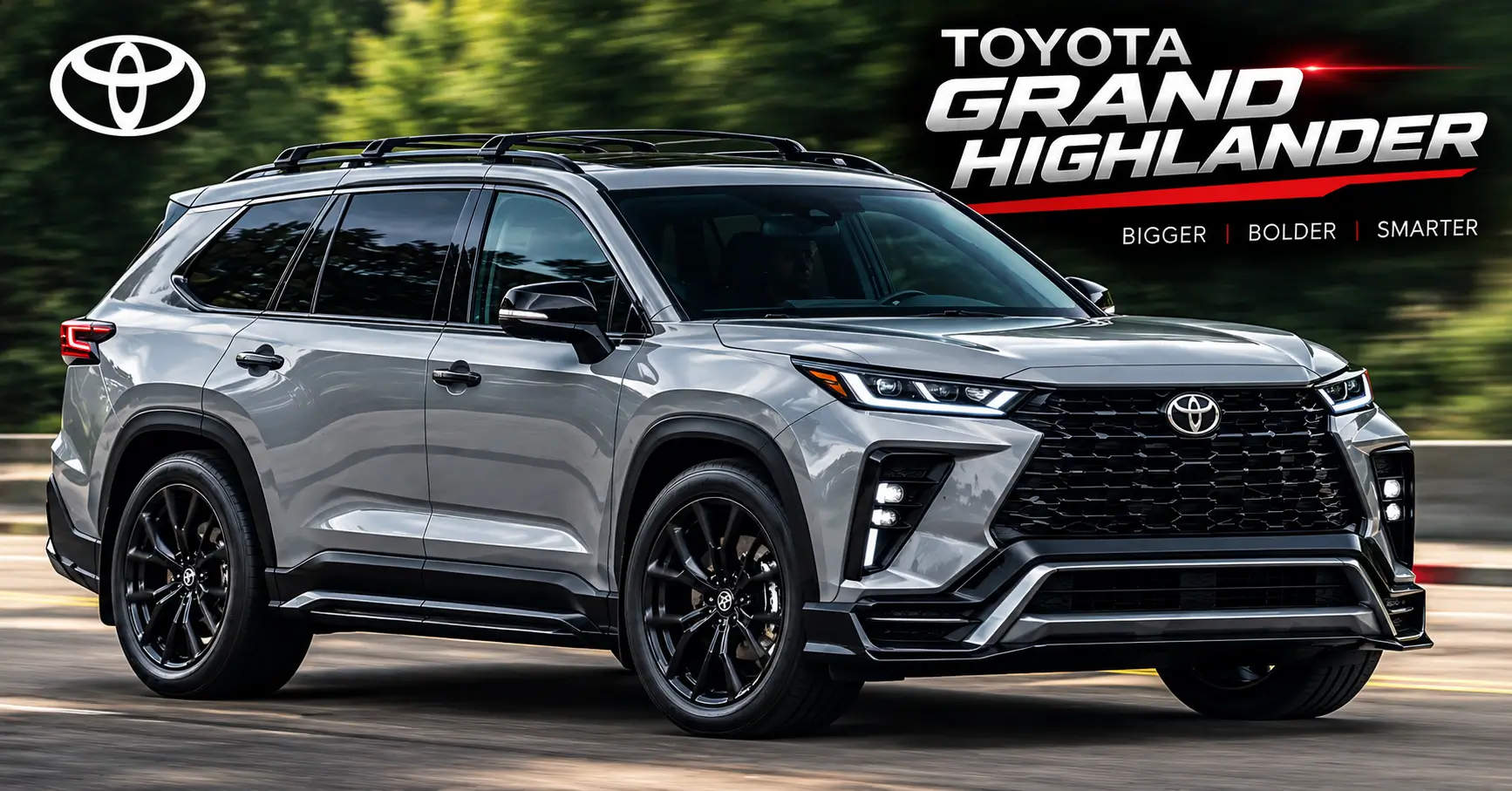
The Toyota Grand Highlander is designed for drivers who need more space than a conventional midsize SUV without moving into a full-size vehicle. Its three-row layout, available hybrid powertrains, generous cargo room, and broad range of trims make it especially appealing to families who want practicality without giving up comfort or technology.
Unlike the regular Highlander, the Grand Highlander puts a stronger emphasis on usable space for passengers and luggage. Toyota offers it with gas, hybrid, and high-performance Hybrid MAX powertrains, giving buyers several ways to balance efficiency, power, and price.
For 2026, the Grand Highlander lineup starts at $42,260 before applicable fees and offers configurations ranging from the practical LE to the upscale Platinum and performance-oriented Hybrid MAX models.
What Is the Toyota Grand Highlander?
The Toyota Grand Highlander is a three-row SUV built around the needs of drivers who regularly carry family members, friends, luggage, or a combination of all three. It sits above the standard Highlander in Toyota’s SUV lineup and provides considerably more room for passengers and cargo.
The key advantage is usability. A three-row SUV can technically seat seven or eight people, but that does not always mean the third row is comfortable or that there is enough luggage space behind it. The Grand Highlander was designed to address that problem.
Toyota says the vehicle can accommodate seven small roller bags behind the third row and provides up to 97.5 cubic feet of rear cargo space with the rear seats folded.
That makes the Grand Highlander a practical choice for family road trips, airport runs, everyday school transportation, and longer journeys where cargo space matters.
Toyota Grand Highlander Powertrains
One of the biggest strengths of the Grand Highlander is its choice of powertrains.
The gas models use a 2.4-liter turbocharged four-cylinder engine producing 265 horsepower and 310 lb-ft of torque. Buyers can choose front-wheel drive on applicable configurations, while Dynamic Torque Control AWD is available on certain gas trims.
The standard hybrid uses a 2.5-liter four-cylinder hybrid powertrain producing 245 net combined horsepower. It is designed more around efficiency than outright performance, making it a strong match for drivers who spend a lot of time commuting or carrying a family.
At the top of the performance range is Hybrid MAX, which combines a turbocharged 2.4-liter engine with an electric motor system to produce 362 net combined horsepower and 400 lb-ft of torque. Hybrid MAX models come with full-time electronic all-wheel drive.
Grand Highlander Powertrain Comparison
| Powertrain | Output | Drivetrain | Best suited for |
|---|---|---|---|
| 2.4L Turbo Gas | 265 hp | FWD or available AWD | Everyday driving and towing needs |
| 2.5L Hybrid | 245 net combined hp | FWD or available AWD, depending on trim | Fuel-conscious family driving |
| 2.4L Turbo Hybrid MAX | 362 net combined hp | Standard AWD | Strong acceleration and performance |
The important distinction is that there is no single “best” powertrain for every buyer. The hybrid makes the most sense when fuel economy is a priority, while Hybrid MAX is better suited to drivers who value stronger acceleration.
Grand Highlander Hybrid: Efficiency Without Giving Up Space
The Toyota Grand Highlander Hybrid is one of the most compelling versions of the SUV because it combines three-row practicality with substantially better fuel economy than the gas models.
For 2026, Toyota lists the Hybrid LE at an estimated 36 city/32 highway MPG, while the Hybrid XLE is rated at an estimated 37 city/34 highway MPG. Other standard hybrid trims are listed at 36 city/32 highway MPG.
The hybrid system is particularly attractive for family drivers who spend thousands of miles each year on commuting, errands, and road trips.
There is also Hybrid MAX for buyers who want considerably more power. It produces 362 horsepower and is rated at an estimated 26 city/27 highway MPG for 2026.
Toyota Grand Highlander Trim Levels
The Grand Highlander lineup gives buyers several price and equipment levels.
For 2026, Toyota lists these primary configurations:
| Trim | Starting MSRP | Estimated MPG |
|---|---|---|
| Grand Highlander LE | $42,260 | 21 city / 28 highway |
| Grand Highlander XLE | $45,030 | 21 city / 28 highway |
| Grand Highlander Limited | $49,760 | 21 city / 28 highway |
| Grand Highlander Platinum | $55,445 | 20 city / 26 highway |
| Grand Highlander Hybrid LE | $45,610 | 36 city / 32 highway |
| Grand Highlander Hybrid XLE | $46,780 | 37 city / 34 highway |
| Grand Highlander Hybrid Limited | $53,110 | 36 city / 32 highway |
| Grand Highlander Hybrid Nightshade | $54,090 | 36 city / 32 highway |
| Grand Highlander Hybrid MAX Limited | $56,090 | 26 city / 27 highway |
| Grand Highlander Hybrid MAX Platinum | $60,175 | 26 city / 27 highway |
These are Toyota’s listed 2026 base MSRPs and estimated fuel-economy figures; actual transaction prices can vary by equipment, destination charges, dealer pricing, and location.
Grand Highlander LE
The LE is the logical starting point for shoppers who want the basic Grand Highlander formula without paying for every available luxury feature.
It makes sense for buyers who prioritize space, practicality, and the core SUV experience over premium equipment.
Grand Highlander XLE
The XLE moves the Grand Highlander further toward comfort and convenience. It is worth considering for buyers who want more equipment without jumping directly to the higher-priced Limited or Platinum trims.
Grand Highlander Limited
The Limited sits toward the upper part of the standard lineup and adds a more premium feel. It is also available with the hybrid powertrain, making it an interesting middle ground between efficiency and luxury.
Grand Highlander Platinum
Platinum is positioned as the premium end of the conventional Grand Highlander range. It is aimed at buyers who want more technology, upscale equipment, and a richer cabin experience.
Hybrid MAX Limited and Platinum
These are the performance-focused versions. With 362 horsepower, standard AWD, and the Hybrid MAX powertrain, they are substantially more powerful than the regular hybrid.
The Platinum version adds further premium equipment, making it the choice for shoppers who want both performance and luxury.
Grand Highlander Interior and Cargo Space
Interior space is one of the main reasons to choose a Grand Highlander.
The cabin is designed around three-row usability rather than simply adding a small third row for occasional use. Toyota specifically positions the vehicle as a three-row SUV capable of comfortably accommodating adults or children.
Cargo flexibility is equally important. With the rear seats folded, Toyota lists up to 97.5 cubic feet of cargo volume.
For a family, that can mean carrying luggage for a weekend trip without asking passengers to sacrifice their seating positions.
A practical example is a family of five heading out for a week-long vacation. In a smaller three-row SUV, luggage can quickly consume the available space behind the third row. The Grand Highlander’s larger cargo area gives that family more flexibility without immediately requiring a roof box or trailer.
Technology and Connectivity
Technology is another important part of the Grand Highlander experience.
Toyota offers a 14-inch Toyota Audio Multimedia touchscreen with wireless Apple CarPlay and Android Auto compatibility on the 2026 model.
Depending on trim, buyers can also move into more premium audio, convenience, and display technology.
Higher-end versions can therefore feel considerably more upscale than the entry-level model, while the basic versions still provide the connectivity most modern drivers expect.
Safety Features
Toyota equips the Grand Highlander with Toyota Safety Sense 3.0, although exact feature availability can vary by trim.
The system includes technologies such as:
- Pre-Collision System with Pedestrian Detection
- Full-Speed Range Dynamic Radar Cruise Control
- Lane Tracing Assist
- Lane Departure Alert
- Automatic High Beams
- Road Sign Assist
Toyota describes these systems as driver-assistance technologies designed to help reduce the risk of collisions and support the driver. They should not be treated as a replacement for attentive driving.
Is the Grand Highlander Better Than the Regular Highlander?
The answer depends on what you need.
The regular Highlander can make more sense if you want a smaller overall package and do not frequently use the third row. The Grand Highlander is the stronger choice when passenger and cargo space are priorities.
The biggest difference is not simply exterior size. It is how that additional space changes daily usability.
If your family frequently carries sports equipment, luggage, groceries, or several adults, the Grand Highlander’s larger cabin can be more useful.
For a detailed comparison, a dedicated Toyota Highlander vs Grand Highlander guide should be consulted because dimensions, seating, cargo capacity, powertrains, and pricing all deserve a closer look.
Who Should Buy a Toyota Grand Highlander?
The Grand Highlander is particularly well suited to:
- Families who regularly use all three rows
- Drivers who want substantial cargo space
- Buyers interested in a three-row hybrid SUV
- Road-trip-focused families
- Drivers who want available AWD
- Shoppers who want more space than a standard midsize SUV
- Buyers who want a performance-oriented three-row SUV through Hybrid MAX
It may be less appealing if your main priority is compact dimensions, low purchase price, or maximum off-road capability.
Related: Toyota Grand Highlander Hybrid
Conclusion
The Toyota Grand Highlander stands out because it focuses on something many three-row SUV buyers actually need: usable space.
Its combination of three-row seating, large cargo capacity, multiple powertrains, available all-wheel drive, modern technology, and a broad trim lineup gives buyers plenty of flexibility. The standard hybrid is particularly attractive for efficiency-focused families, while Hybrid MAX provides a very different experience with 362 horsepower and standard AWD.
For 2026, the lineup ranges from the $42,260 Grand Highlander LE to the $60,175 Hybrid MAX Platinum, giving shoppers a wide range of equipment and performance choices.
Ultimately, the best Grand Highlander is the one that matches your priorities. Choose the standard model if simplicity and value matter most, the hybrid if fuel economy is a major concern, or Hybrid MAX if stronger performance is worth the additional cost.
FAQs
Is the Toyota Grand Highlander a good family SUV?
Yes. Its three-row layout, generous cargo capacity, and available hybrid powertrain make it particularly well suited to families that need passenger and luggage space.
How many people can the Grand Highlander seat?
Depending on configuration, the Grand Highlander can seat up to eight people.
How much cargo space does the Grand Highlander have?
Toyota lists up to 97.5 cubic feet of cargo capacity with the rear seats folded.
Does the Grand Highlander come as a hybrid?
Yes. Toyota offers a 2.5-liter hybrid powertrain as well as the more powerful 362-horsepower Hybrid MAX configuration.
What is the 2026 Grand Highlander starting price?
Toyota lists the 2026 Grand Highlander LE at a starting MSRP of $42,260 before applicable fees and other costs.
Which Grand Highlander is best for fuel economy?
The standard Grand Highlander Hybrid is the efficiency-focused choice. For 2026, Toyota lists the Hybrid XLE at an estimated 37 city/34 highway MPG, while other standard hybrid trims are rated at an estimated 36 city/32 highway MPG.




Leave a Reply