
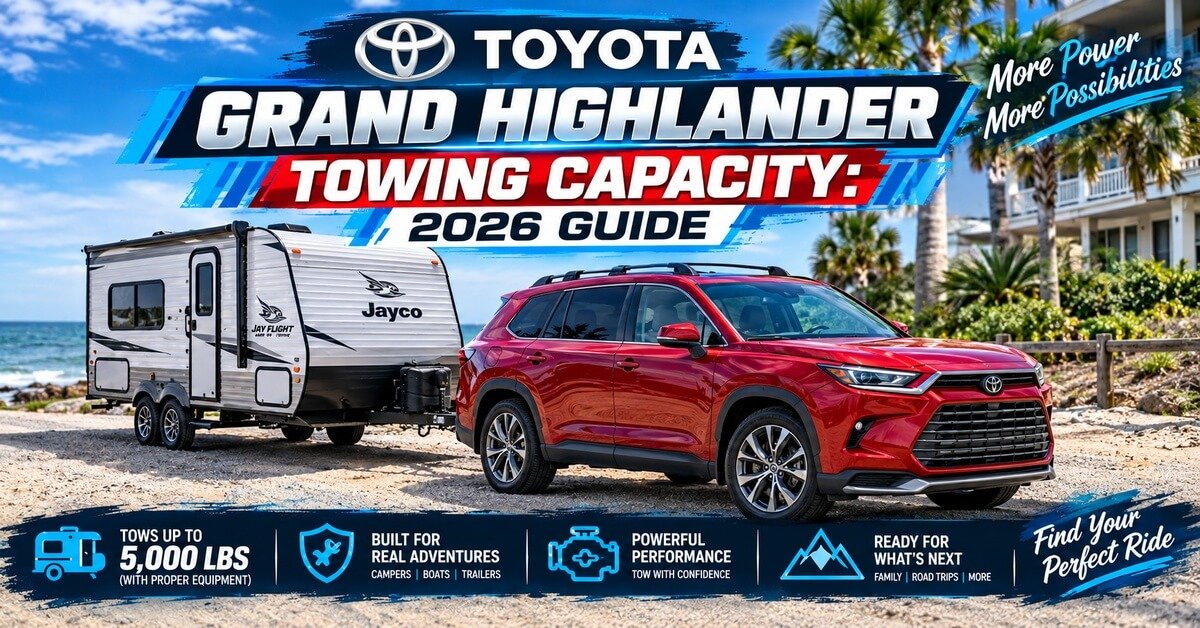
The Toyota Grand Highlander towing capacity is an important consideration for families who want a three-row SUV that can handle more than passengers and luggage.
Whether you’re towing a small camper, utility trailer, boat, or recreational equipment, the Grand Highlander offers useful towing capability without requiring buyers to move into a full-size SUV.
However, towing capacity isn’t identical across the entire lineup. The engine, hybrid system, drivetrain, and configuration all matter.
The maximum rating can reach 5,000 pounds on properly equipped Grand Highlander models, but buyers should always verify the rating for the exact vehicle they plan to purchase.
2026 Toyota Grand Highlander Towing Capacity
The Grand Highlander’s towing capability varies by powertrain.
| Powertrain | Maximum Towing Capacity | Best For |
|---|---|---|
| 2.4L Turbo Gas | Up to 5,000 lbs | Family and recreational towing |
| 2.5L Hybrid | Up to 5,000 lbs on properly equipped models | Efficient family towing |
| 2.4L Turbo Hybrid MAX | Up to 5,000 lbs | Strong acceleration while towing |
The maximum figure applies only to properly equipped configurations.
Towing capacity should never be assumed based solely on the engine name or trim badge.
How Much Can the Toyota Grand Highlander Tow?
A properly equipped Grand Highlander can tow up to 5,000 pounds.
That’s enough for many common recreational applications.
For example, the capacity can potentially accommodate:
- Small travel trailers
- Lightweight boats
- Utility trailers
- Small campers
- Motorcycles
- Recreational equipment
The actual trailer weight is only one part of the equation.
You also need to consider passengers, cargo, tongue weight, hitch equipment, and the vehicle’s overall weight limits.
Grand Highlander Towing Capacity by Engine
Different Grand Highlander powertrains deliver different driving characteristics.
2.4-Liter Turbo Gas
The standard gasoline engine is a 2.4-liter turbocharged four-cylinder.
It produces approximately 265 horsepower and provides useful torque for everyday driving and towing.
For buyers who need practical towing capability without choosing a hybrid, this powertrain is a sensible option.
2.5-Liter Hybrid
The standard hybrid uses a 2.5-liter engine and electric motors.
It produces 245 net combined horsepower.
The hybrid’s primary advantage is fuel efficiency.
For buyers who only tow occasionally but spend most of their time commuting, the hybrid can provide a useful balance between everyday efficiency and towing capability.
2.4-Liter Turbo Hybrid MAX
Hybrid MAX is the performance-focused option.
It produces:
362 net combined horsepower and 400 lb-ft of torque.
It also comes with standard all-wheel drive.
This extra power can make acceleration feel more confident when the vehicle is carrying passengers and pulling a trailer.
Does Every Grand Highlander Tow 5,000 Pounds?
No.
The 5,000-pound figure should be treated as a maximum rating for properly equipped configurations, not a universal rating for every Grand Highlander.
Equipment and configuration can affect towing capability.
Before purchasing a vehicle specifically for towing, verify:
- Engine
- Drivetrain
- Trim
- Factory towing equipment
- Hitch requirements
- Maximum trailer weight
- Maximum tongue weight
- Payload capacity
The vehicle’s documentation should take priority over a general online specification.
Grand Highlander Towing Package
If you’re planning to tow regularly, the appropriate factory equipment matters.
Depending on configuration, towing-related equipment can include hardware and systems designed to support trailer use.
Before buying, ask the dealer to confirm that the vehicle has the equipment required for the trailer you intend to tow.
Don’t assume that adding a hitch automatically gives the SUV its maximum towing rating.
The entire vehicle configuration needs to be suitable for the load.
Grand Highlander Towing and Payload Capacity
Towing capacity and payload capacity are different.
Towing capacity refers to how much trailer weight the vehicle can pull.
Payload capacity refers to the weight carried by the SUV itself.
Payload includes:
- Driver
- Passengers
- Luggage
- Cargo
- Hitch-related weight
This distinction is extremely important.
A trailer may weigh less than the maximum towing rating while the SUV is still overloaded because of passengers, cargo, and tongue weight.
Understanding Tongue Weight
Tongue weight is the downward force the trailer places on the hitch.
It is an important part of towing safety and vehicle loading.
For example, if a trailer weighs 4,000 pounds, the tongue weight can represent a significant portion of that total.
That weight counts against the vehicle’s payload capacity.
This means you can’t simply look at a 5,000-pound maximum towing rating and assume that a fully loaded SUV can always tow a 5,000-pound trailer.
The complete weight calculation matters.
Grand Highlander Towing for Families
The Grand Highlander’s towing capability makes it useful for families with recreational equipment.
Imagine a family that normally uses the SUV for school runs and commuting.
On weekends, they want to tow a small camper to a nearby campground.
A properly configured Grand Highlander can potentially handle that role while still functioning as a comfortable three-row family vehicle during the week.
That versatility is one of the biggest advantages of a midsize three-row SUV.
Grand Highlander Towing a Camper
Small campers are one of the most common reasons families consider SUV towing capacity.
Before choosing a camper, don’t compare only its advertised dry weight.
You should consider its loaded weight.
Camping equipment can add:
- Food
- Water
- Clothing
- Cooking equipment
- Outdoor gear
- Batteries
- Propane
- Personal belongings
A camper that looks comfortably below the SUV’s maximum towing capacity when empty can become much heavier when fully loaded.
Grand Highlander Towing a Boat
The Grand Highlander can also be considered for certain lightweight boat-and-trailer combinations.
But again, don’t focus only on the boat’s advertised weight.
You need to account for:
- Trailer
- Fuel
- Battery
- Equipment
- Water
- Safety gear
The combined weight is what matters.
If the total approaches the vehicle’s limits, a larger tow vehicle may be more appropriate.
Grand Highlander Towing a Utility Trailer
A utility trailer can be relatively easy to tow when properly loaded.
Common uses include transporting:
- Landscaping equipment
- Home-improvement supplies
- Motorcycles
- Outdoor equipment
- Household materials
Proper weight distribution is important.
Heavy objects should not simply be placed at the rear or front of the trailer.
The load should be secured and distributed according to safe towing practices.
Grand Highlander Hybrid Towing Capacity
The hybrid is particularly interesting because it combines towing capability with better fuel economy.
For drivers who tow only occasionally, this can be an attractive combination.
Most of the year, the SUV can function as an efficient family vehicle.
When necessary, it can also handle a properly rated trailer.
However, if towing is a frequent activity, you should pay close attention to the exact configuration and the trailer’s loaded weight.
Grand Highlander Hybrid MAX Towing
Hybrid MAX combines the Grand Highlander’s three-row practicality with its most powerful powertrain.
With 362 net combined horsepower and 400 lb-ft of torque, it provides substantially more power than the standard hybrid.
That doesn’t automatically mean it can tow more than every other configuration.
Towing capacity remains dependent on the vehicle’s official rating and equipment.
The main benefit of Hybrid MAX is the stronger performance and acceleration.
Does Hybrid MPG Change When Towing?
Yes.
Towing adds weight and aerodynamic resistance.
The vehicle therefore requires more energy to move.
A trailer can have a particularly significant effect on highway fuel economy because of its additional aerodynamic drag.
Don’t expect the same MPG you achieve while driving without a trailer.
This is true even for a highly efficient hybrid.
Grand Highlander Towing and AWD
All-wheel drive can be valuable when towing because it can improve traction during acceleration on slippery surfaces.
This can be useful when launching a boat, pulling away on wet pavement, or traveling on gravel.
However, AWD doesn’t eliminate the need for proper trailer loading or safe driving.
You still need:
- Correct tire pressure
- Proper hitch setup
- Appropriate trailer brakes when required
- Correct weight distribution
- Safe speeds
- Adequate stopping distance
Grand Highlander Towing on Hills
Towing uphill places additional demands on the powertrain.
A trailer increases the total mass the vehicle must move.
Steep grades can therefore make acceleration slower and increase engine and drivetrain workload.
Hybrid MAX’s additional power can be useful in these conditions, although you should still remain within the vehicle’s rated limits.
Downhill driving matters too.
The vehicle needs to control speed safely, which is why proper trailer setup and conservative driving are essential.
Grand Highlander Towing and Braking
Stopping a trailer safely is just as important as pulling it.
The trailer’s brakes, if equipped or required, should be properly maintained and connected.
You should also leave additional following distance.
A heavier combined vehicle takes more time and distance to slow down.
Avoid sudden braking whenever possible.
Plan your stops early, especially when traveling downhill or in heavy traffic.
Grand Highlander Towing in Hot Weather
High temperatures can make towing more demanding.
Hot weather can increase the workload on the engine, cooling system, transmission, tires, and brakes.
If you’re towing in very hot conditions, pay attention to:
- Vehicle temperature warnings
- Tire condition
- Trailer tire condition
- Engine performance
- Brake performance
- Proper loading
If your route includes steep grades and extreme heat, plan accordingly.
Grand Highlander Towing in Winter
Winter towing introduces additional challenges.
Snow, ice, and cold temperatures can reduce traction.
A trailer can make slippery conditions even more difficult to manage.
If you’re towing during winter:
- Use appropriate tires
- Reduce speed
- Increase following distance
- Avoid abrupt steering
- Check the trailer before departure
- Keep loads properly secured
AWD can help with traction, but it cannot overcome the laws of physics on ice.
What Can a 5,000-Pound Towing Capacity Tow?
A 5,000-pound maximum gives the Grand Highlander useful flexibility.
It can potentially handle many smaller recreational trailers.
Examples may include:
- Lightweight travel trailers
- Small campers
- Lightweight boats
- Utility trailers
- Motorcycles
- Recreational equipment
However, always compare the actual loaded weight of the trailer with the exact vehicle’s rating.
Don’t choose a trailer based solely on its dry weight.
How to Calculate Trailer Weight
A simple example illustrates why loaded weight matters.
Suppose a camper has a dry weight of 3,800 pounds.
You add:
- 300 pounds of gear
- 200 pounds of water
- 150 pounds of equipment
- 100 pounds of additional supplies
The loaded trailer is now:
4,550 pounds
That is substantially different from the original 3,800-pound figure.
The example demonstrates why buyers should estimate the trailer’s realistic travel weight before purchasing.
Grand Highlander Towing vs Highlander
The Grand Highlander offers a larger overall package than the standard Highlander.
Its additional size gives families more passenger and cargo flexibility.
| Category | Grand Highlander | Highlander |
|---|---|---|
| Vehicle size | Larger | Smaller |
| Seating | Up to 8 | Up to 8 |
| Maximum towing | Up to 5,000 lbs on properly equipped models | Configuration dependent |
| Main advantage | Space + towing flexibility | Smaller footprint |
If your priority is maximum family space, the Grand Highlander has an obvious advantage.
If you rarely use the third row or tow, the smaller Highlander may be easier to maneuver.
Grand Highlander Towing vs Other Three-Row SUVs
A maximum towing rating of around 5,000 pounds places the Grand Highlander in a useful position among family-oriented three-row SUVs.
But towing capacity isn’t the only thing to compare.
Also consider:
- Payload
- Trailer stability
- Powertrain
- Braking
- Wheelbase
- Cargo capacity
- Fuel economy
- Price
A vehicle with a higher maximum towing rating isn’t necessarily the better family vehicle.
Choose the vehicle that matches your actual trailer and passenger needs.
How Does Towing Affect Grand Highlander Handling?
A trailer changes how the SUV behaves.
Acceleration becomes slower.
Braking distances increase.
Turning requires more planning.
Crosswinds can affect the trailer.
The combined vehicle also requires more space when changing lanes.
That’s why towing should be approached differently from normal driving.
Start slowly and become familiar with how the SUV behaves before taking a long trip.
Tips for Safe Grand Highlander Towing
Before every towing trip:
Check Tire Pressure
Inspect both the SUV and trailer tires.
Verify Hitch Connections
Make sure the trailer is properly attached.
Check Trailer Lights
Confirm brake lights, turn signals, and running lights work correctly.
Secure the Cargo
Loose items can shift during travel.
Confirm Weight
Know the trailer’s loaded weight.
Distribute Weight Correctly
Avoid an improperly balanced trailer.
Allow More Stopping Distance
Don’t follow other vehicles too closely.
Drive Smoothly
Avoid aggressive acceleration, steering, and braking.
Is the Grand Highlander Good for Towing?
Yes, for the right type of towing.
The Grand Highlander’s ability to tow up to 5,000 pounds when properly equipped gives it useful capability for many family and recreational applications.
It is particularly appealing if towing is only one part of your vehicle’s job.
You can use it as a daily family SUV and tow a camper or trailer when necessary.
If you’re towing very heavy trailers frequently, however, a dedicated truck or larger SUV may be more appropriate.
Which Grand Highlander Is Best for Towing?
There isn’t a single answer.
Best for Efficiency
Grand Highlander Hybrid
Ideal for drivers who tow occasionally but prioritize fuel economy during everyday driving.
Best for Performance
Grand Highlander Hybrid MAX
The 362-horsepower powertrain provides substantially stronger acceleration.
Best Conventional Choice
Grand Highlander 2.4L Turbo Gas
A practical option for buyers who prefer a conventional gasoline powertrain.
The most important factor remains the exact vehicle’s certified towing and payload ratings.
Related: Toyota Grand Highlander Towing Capacity
Conclusion
The Toyota Grand Highlander towing capacity makes the SUV more versatile than a typical family crossover.
A properly equipped Grand Highlander can tow up to 5,000 pounds, giving it enough capability for many lightweight campers, boats, utility trailers, and recreational loads.
The standard gasoline model provides conventional turbocharged performance, while the standard hybrid emphasizes fuel efficiency.
Hybrid MAX takes the performance approach with 362 net combined horsepower and 400 lb-ft of torque.
But the maximum number isn’t the only specification that matters.
Before towing, you need to consider the trailer’s loaded weight, tongue weight, passenger and cargo weight, hitch equipment, and the vehicle’s official payload and towing limits.
If you tow occasionally, the Grand Highlander can be an excellent combination of family practicality and recreational capability.
If towing is your primary reason for buying an SUV, however, compare its complete towing specifications against the trailer you actually plan to use.
The safest choice is always to leave an appropriate margin below the vehicle’s maximum limits rather than operating at the edge of its capacity.
FAQs
How much can the Toyota Grand Highlander tow?
A properly equipped Grand Highlander can tow up to 5,000 pounds, although the exact rating depends on configuration and equipment.
Does every Grand Highlander tow 5,000 pounds?
No. The 5,000-pound figure applies to properly equipped configurations. Buyers should verify the exact rating of the vehicle they intend to purchase.
Can the Grand Highlander tow a camper?
Yes. A properly configured Grand Highlander can tow many lightweight campers, but the camper’s fully loaded weight must remain within the vehicle’s towing and payload limits.
Can a Grand Highlander tow a boat?
It can tow certain lightweight boat-and-trailer combinations. You should calculate the combined loaded weight of the boat, trailer, fuel, equipment, and other gear.
What is the Grand Highlander Hybrid towing capacity?
Certain properly equipped Grand Highlander Hybrid configurations can tow up to 5,000 pounds. Verify the exact rating for the specific vehicle.
Is Hybrid MAX better for towing?
Hybrid MAX provides substantially more power, with 362 net combined horsepower and 400 lb-ft of torque. However, towing capacity still depends on the official rating and equipment.
Does towing reduce Grand Highlander MPG?
Yes. A trailer adds weight and aerodynamic drag, which can significantly reduce fuel economy.
Can the Grand Highlander tow 5,000 pounds safely?
A properly equipped vehicle can tow within its certified limits when the trailer is correctly loaded and the required equipment and safe towing practices are followed.
Does AWD help when towing?
AWD can improve traction during acceleration on slippery surfaces, but it does not increase the vehicle’s certified towing capacity.
What is the difference between towing capacity and payload?
Towing capacity refers to the maximum trailer weight the vehicle can pull, while payload refers to the weight carried inside the SUV and on the vehicle itself.
Should I tow at the maximum capacity?
It’s generally better to maintain an appropriate safety margin rather than routinely operating at the absolute maximum. Always follow Toyota’s specifications and applicable towing guidance.
Is the Grand Highlander good for long-distance towing?
It can be suitable for properly sized trailers, provided the vehicle remains within its towing and payload limits and the driver uses appropriate towing practices.



Leave a Reply