
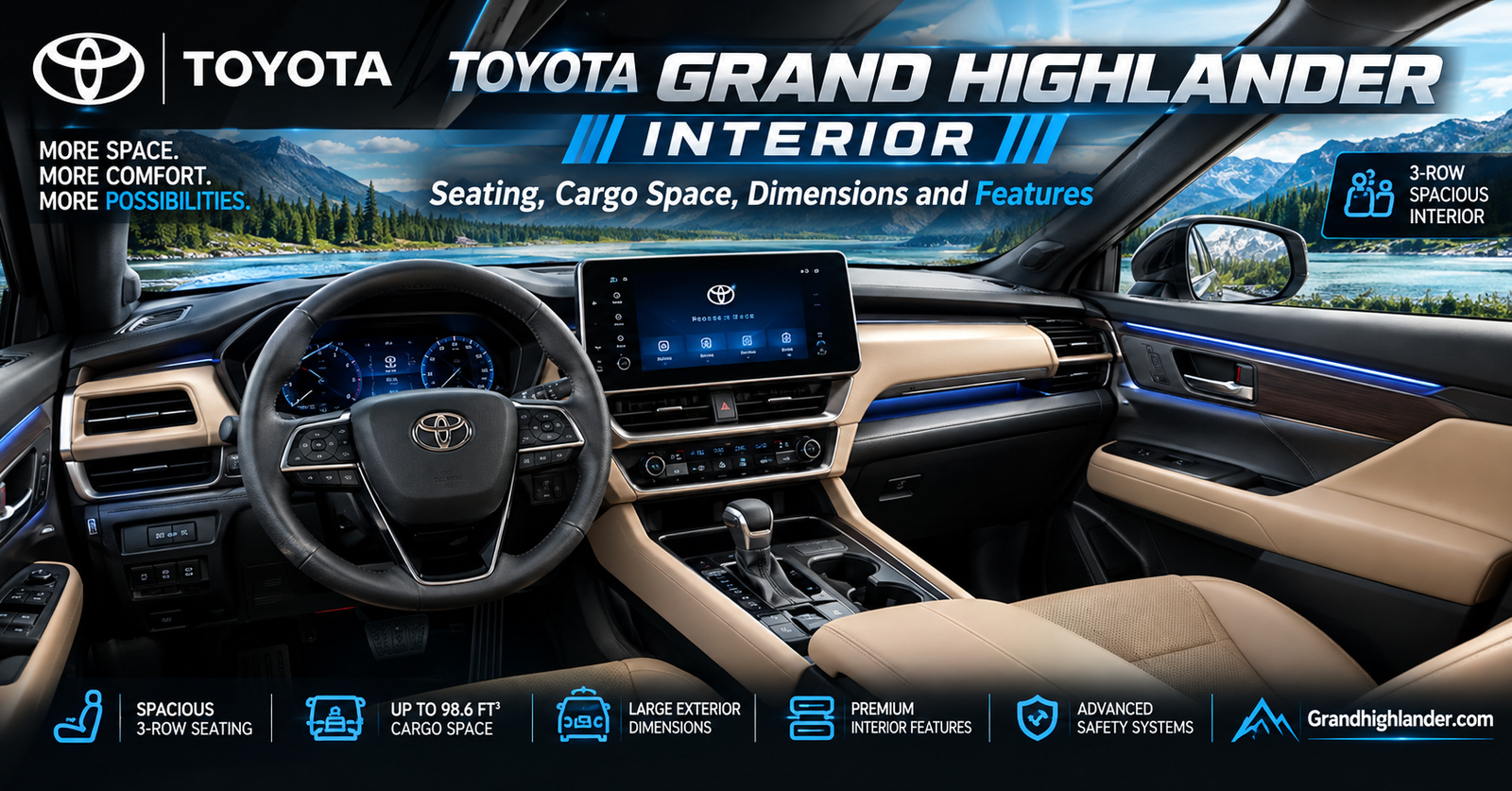
The Toyota Grand Highlander interior is one of the main reasons shoppers choose this three-row SUV over a smaller crossover. Toyota designed the Grand Highlander around usable passenger and cargo space, rather than simply adding a third row and calling it a family vehicle.
That distinction matters.
A three-row SUV can technically seat seven or eight people, but that doesn’t always mean the third row is comfortable or that there is enough room for luggage. The Grand Highlander takes a different approach by providing a larger cabin, flexible seating, and substantial cargo capacity.
For families, the result is an SUV that can handle school runs during the week and long road trips on the weekend without requiring passengers to constantly compromise on space.
Toyota Grand Highlander Interior at a Glance
The Grand Highlander’s interior is designed around three major priorities:
- Passenger space
- Cargo flexibility
- Everyday convenience
Depending on configuration, the SUV can seat up to eight passengers.
Toyota also lists up to 97.5 cubic feet of cargo volume with the rear seats folded.
That combination makes the Grand Highlander particularly attractive to families who need three rows but don’t want the cramped cargo area often associated with three-row SUVs.
How Many People Can the Grand Highlander Seat?
The Toyota Grand Highlander can seat up to eight people, depending on the configuration.
The exact seating arrangement depends on whether the vehicle is equipped with a second-row bench seat or captain’s chairs.
A second-row bench provides maximum seating capacity, while captain’s chairs can create a more open and comfortable second-row arrangement.
For families with several children, the eight-passenger configuration can be useful. For buyers who frequently carry adults, captain’s chairs may be more appealing because they make access to the third row easier.
Grand Highlander Third-Row Seating
The third row is one of the most important parts of the Grand Highlander’s design.
Toyota developed the vehicle with the intention of making the third row genuinely useful for family transportation.
That’s important because many three-row SUVs offer a third row that works best for children but becomes uncomfortable for adults during longer journeys.
The Grand Highlander gives the rear passengers more usable space, making it better suited to situations where the third row is used regularly rather than only in emergencies.
For a family road trip, this can make a noticeable difference.
Instead of treating the third row as an occasional seat, you can use it as part of the vehicle’s normal passenger capacity while retaining useful cargo room.
Grand Highlander Second-Row Seating
The second row provides a choice between maximum seating capacity and easier third-row access.
A bench configuration can allow the Grand Highlander to carry up to eight passengers.
Captain’s chairs reduce seating capacity but provide a more individual seating arrangement and a center passage between the seats.
This choice is worth considering based on how your family actually uses the SUV.
If you regularly carry seven or eight people, the bench may be more practical.
If six or seven passengers are typical and third-row access is important, captain’s chairs may be the better configuration.
Grand Highlander Cargo Space
Cargo capacity is arguably one of the Grand Highlander’s strongest interior advantages.
Toyota lists up to 97.5 cubic feet of cargo capacity with the rear seats folded.
But maximum cargo volume is only part of the story.
What matters in daily life is how much space remains when passengers are using the vehicle.
The Grand Highlander provides useful cargo room behind the third row, meaning you can carry luggage without automatically folding the rear seats.
That’s especially important for family travel.
Imagine six passengers leaving for a week-long vacation. Everyone needs a seat, but everyone also has luggage. In a smaller three-row SUV, that situation can become a puzzle. The Grand Highlander’s larger cargo area provides more flexibility.
Grand Highlander Cargo Configurations
The rear seating can be folded to create additional cargo space when you don’t need all three rows.
This gives the SUV several practical configurations:
All Three Rows in Use
This setup is ideal when passenger capacity is the priority.
You can transport several people while still retaining cargo space behind the third row.
Third Row Folded
Folding the third row creates substantially more room for luggage, groceries, sports equipment, or other bulky items.
This can be the most useful configuration for families who normally carry five or fewer passengers.
Rear Rows Folded
When maximum cargo capacity is required, folding the rear seating creates a large, relatively flat cargo area.
This is useful for moving large items or transporting bulky equipment.
Grand Highlander Interior Dimensions
The Grand Highlander’s dimensions contribute directly to its interior practicality.
Toyota positions it as a larger three-row SUV than the standard Highlander, with additional length dedicated to passenger and cargo space.
Rather than focusing solely on exterior dimensions, shoppers should look at what those dimensions accomplish inside the cabin.
The important advantages are:
- More useful third-row space
- Better cargo flexibility
- More room for passengers
- Easier family loading
- Greater versatility for road trips
If you are comparing the Grand Highlander with the regular Highlander, the difference becomes especially relevant when all three rows are occupied.
Grand Highlander Legroom
Legroom is particularly important in a three-row vehicle because the third row is often where smaller SUVs compromise.
The Grand Highlander’s larger overall package gives Toyota more room to work with when designing the passenger compartment.
That makes the vehicle more practical for families with older children or adults who occasionally use the third row.
Of course, perceived comfort depends on passenger height and seating position. A very tall adult will experience a three-row SUV differently from a child or average-height passenger.
For this reason, anyone who plans to regularly transport adults in the third row should test the exact configuration before buying.
Grand Highlander Headroom
The cabin also provides useful headroom across the three rows.
This becomes particularly important for taller passengers.
A high roofline helps provide the upright seating position expected from an SUV while creating additional vertical space for passengers.
The result is a cabin that feels more open than a low-roof crossover.
Grand Highlander Interior Storage
A family vehicle needs more than seats.
It also needs places to store phones, drinks, chargers, snacks, small bags, and other everyday items.
The Grand Highlander provides multiple storage areas throughout the cabin to support this type of daily use.
This is easy to overlook when comparing specifications, but small storage solutions can have a surprisingly large effect on long-term usability.
A vehicle that works well for a family isn’t necessarily the one with the longest list of luxury features. Often, it’s the one that makes everyday tasks easier.
Grand Highlander Interior Technology
The Grand Highlander combines its spacious cabin with modern infotainment technology.
The 2026 model offers a 14-inch Toyota Audio Multimedia touchscreen, along with wireless Apple CarPlay and Android Auto compatibility.
These features allow drivers and passengers to connect smartphones without needing to rely exclusively on the vehicle’s built-in applications.
For a family SUV, this can be especially useful during road trips when passengers want access to navigation, music, calls, and other compatible smartphone functions.
Higher trims add more premium equipment and technology.
Grand Highlander Interior Comfort
Interior comfort varies by trim, but the overall cabin design emphasizes practicality and long-distance usability.
The lower trims focus more heavily on value, while higher trims such as Limited and Platinum add additional premium-oriented equipment.
This gives buyers the ability to choose the level of interior refinement that fits their budget.
If you spend only short periods in your SUV, an entry-level trim may be perfectly adequate.
If the vehicle will be used for frequent long-distance travel, the additional comfort features of a higher trim may become easier to appreciate.
Grand Highlander Interior for Families
The Grand Highlander’s interior is particularly well suited to family life.
Consider a typical day.
In the morning, the SUV may carry children to school. After work, it may transport groceries. In the evening, sports equipment and several passengers may fill the cabin.
On the weekend, the same vehicle might carry the entire family and luggage on a road trip.
That range of uses is where the Grand Highlander makes the strongest case for itself.
It isn’t designed around one specific scenario. Its larger cabin gives it the flexibility to handle several.
Grand Highlander Interior vs Highlander Interior
The regular Highlander and Grand Highlander are both three-row SUVs, but the Grand Highlander places a stronger emphasis on usable interior space.
The biggest difference becomes apparent when you’re using all three rows.
If the third row is rarely used, the regular Highlander may provide enough space.
If your family regularly carries seven or eight passengers, the Grand Highlander’s additional room becomes more valuable.
The same applies to cargo.
A family that travels frequently with luggage may appreciate the Grand Highlander’s ability to maintain useful storage while the third row is occupied.
Is the Grand Highlander Interior Bigger Than the Highlander?
Yes, the Grand Highlander is designed as the larger and more spacious member of Toyota’s three-row SUV family.
Its increased size is used to provide more passenger and cargo flexibility.
This doesn’t automatically make it the better choice for everyone.
If you rarely use the third row, the regular Highlander may be easier to live with.
But if three-row usability is one of your main priorities, the Grand Highlander’s interior is a major reason to choose it.
Is the Grand Highlander Good for Tall Passengers?
The Grand Highlander is a strong option for taller passengers compared with many smaller three-row SUVs, particularly because of its larger cabin.
However, comfort is subjective.
A six-foot-plus adult should sit in the second and third rows before buying if those seats will be used regularly.
Pay attention to:
- Knee clearance
- Headroom
- Seat cushion length
- Foot space
- Ease of entry and exit
- Ability to adjust the seat in front
This is more useful than relying solely on a specification sheet.
Is the Grand Highlander Good for Road Trips?
The interior is one of the reasons it works well for road trips.
A successful family road trip requires more than passenger seating. You need room for luggage, food, electronics, personal items, and everything else passengers bring along.
The Grand Highlander’s combination of three-row seating and substantial cargo capacity makes it well suited to this role.
With the third row in use, you retain useful storage behind it. Folding the third row creates significantly more cargo capacity when fewer passengers are traveling.
Grand Highlander Interior: Gas vs Hybrid
One concern some shoppers have is whether choosing the hybrid version means sacrificing interior practicality.
The Grand Highlander Hybrid retains the same fundamental three-row SUV concept.
The key reason to choose the hybrid is the powertrain and fuel economy rather than a different interior mission.
That makes the decision relatively simple:
Choose gas if you prefer the conventional powertrain and want the lower entry price.
Choose hybrid if improved fuel economy is more important.
The interior remains one of the central strengths of the Grand Highlander either way.
Which Grand Highlander Trim Has the Best Interior?
The answer depends on what you mean by “best.”
If you mean most affordable, the LE provides the core interior and three-row functionality.
If you mean best balance, XLE is worth considering.
If you mean more premium, Limited offers a higher equipment level.
If you want the most upscale conventional configuration, Platinum is the top choice.
And if you want premium equipment combined with the most powerful powertrain, Hybrid MAX Platinum sits at the top of the lineup.
Practical Interior Features That Matter Most
When evaluating the Grand Highlander interior, focus on the features that affect daily life.
Passenger space
Make sure the second and third rows are comfortable for the people who will actually use them.
Cargo flexibility
Think about whether you can carry your normal luggage while keeping enough seats available.
Storage
Check whether there are enough useful places for drinks, phones, bags, and other everyday items.
Technology
Consider whether the infotainment system and smartphone connectivity meet your expectations.
Access
Third-row entry can matter as much as third-row space, particularly when children or older passengers regularly use the rear seats.
Related: Toyota Grand Highlander Platinum: Price, Features, Specs and Complete Guide
Conclusion
The Toyota Grand Highlander interior is one of the SUV’s strongest selling points.
Its larger three-row cabin provides useful passenger space, flexible seating configurations, and substantial cargo capacity. Toyota lists up to 97.5 cubic feet of cargo volume with the rear seats folded, while seating capacity can reach eight depending on configuration.
More importantly, the interior is designed around real family needs.
You can use all three rows, carry luggage, fold seats when necessary, and adapt the cabin to different situations.
For shoppers deciding between the regular Highlander and Grand Highlander, the question should be simple: How often will you need all three rows and how much cargo space do you normally carry?
If the answer is “often,” the Grand Highlander’s larger and more flexible interior can make a meaningful difference.
FAQs
How many people can the Toyota Grand Highlander seat?
The Grand Highlander can seat up to eight passengers, depending on the seating configuration.
How much cargo space does the Grand Highlander have?
Toyota lists up to 97.5 cubic feet of cargo capacity with the rear seats folded.
Is the Grand Highlander bigger than the Highlander?
Yes. The Grand Highlander is the larger model and provides additional passenger and cargo space compared with the standard Highlander.
Is the Grand Highlander good for families?
Yes. Its three-row seating, flexible cargo area, and available hybrid powertrain make it particularly well suited to family transportation.
Can adults sit in the Grand Highlander’s third row?
Yes. The Grand Highlander was designed with a more usable third row than many smaller three-row SUVs. However, taller adults should test the third row personally because comfort varies by body size and seating position.
Does the Grand Highlander have good cargo space behind the third row?
Yes. One of its advantages is retaining useful cargo capacity even when all three rows are occupied.
Does the Grand Highlander Hybrid have the same interior space?
The hybrid retains the Grand Highlander’s three-row family-oriented interior concept. The primary difference between gas and hybrid versions is the powertrain rather than the vehicle’s overall purpose.
Does the Grand Highlander have a large touchscreen?
The 2026 Grand Highlander offers a 14-inch Toyota Audio Multimedia touchscreen, along with wireless Apple CarPlay and Android Auto compatibility.




Leave a Reply