
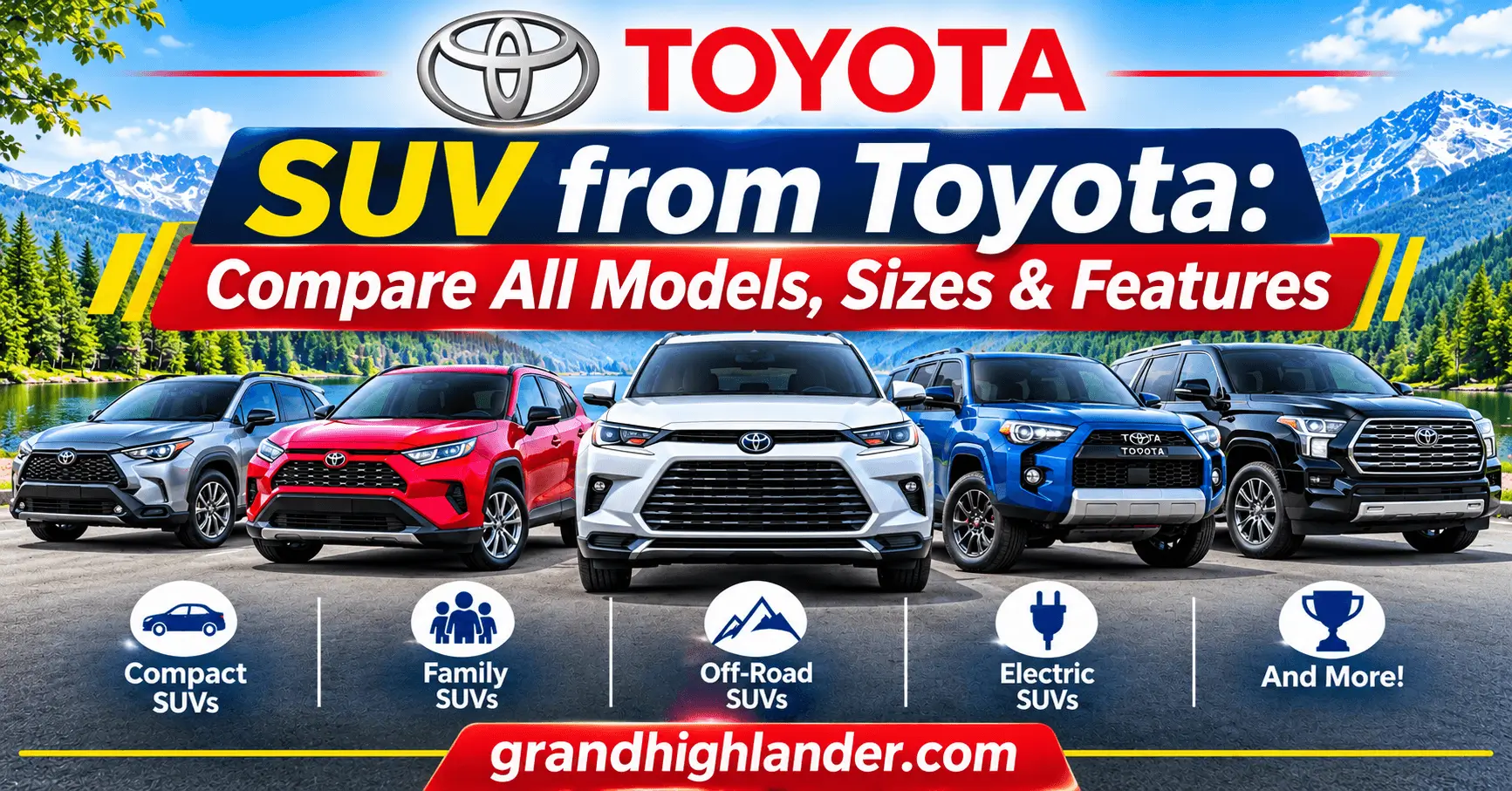
Toyota offers a diverse SUV lineup in the United States, with options for city driving, family transportation, off-road adventures, and fuel-conscious commuting. Its range includes compact crossovers, midsize SUVs, three-row family vehicles, and full-size models designed for greater passenger and cargo capacity.
Choosing the right SUV from Toyota depends on more than appearance or price. Seating capacity, interior space, powertrain, ground clearance, fuel economy, and intended use all influence which model makes the most sense.
This guide covers Toyota SUV models from smallest to largest, explains their main differences, and highlights which options suit different drivers. Whether you want an affordable compact SUV, a spacious seven-seater, or a capable off-road vehicle, understanding the lineup makes your decision easier.
What Are the Different Toyota SUV Models?
Toyota’s US SUV lineup includes several models designed for different needs. Some prioritize everyday comfort and efficiency, while others focus on rugged performance, passenger space, or electric driving.
Here are the main Toyota SUV models to know:
- Toyota Corolla Cross
- Toyota RAV4
- Toyota RAV4 Plug-in Hybrid
- Toyota bZ
- Toyota bZ Woodland
- Toyota Crown Signia
- Toyota 4Runner
- Toyota Highlander
- Toyota Grand Highlander
- Toyota Land Cruiser
- Toyota Sequoia
Not every model serves the same purpose. For example, the Corolla Cross is suited to drivers who want a smaller vehicle that’s easy to maneuver, while the Sequoia provides considerably more room for families and passengers.
Toyota SUV Models From Smallest to Largest
Toyota’s SUV lineup covers multiple size categories. Although exact exterior dimensions vary by model year and configuration, the following order provides a useful general comparison.
| Toyota SUV | Vehicle Category | Seating Capacity | Main Purpose |
|---|---|---|---|
| Corolla Cross | Subcompact SUV | 5 | Everyday commuting |
| bZ | Compact electric SUV | 5 | Electric driving |
| RAV4 | Compact SUV | 5 | Daily use and family travel |
| RAV4 Plug-in Hybrid | Compact plug-in hybrid SUV | 5 | Electric-assisted driving |
| Crown Signia | Midsize crossover | 5 | Comfort and efficiency |
| bZ Woodland | Electric adventure-oriented SUV | 5 | Electric utility and outdoor use |
| 4Runner | Midsize off-road SUV | 5 or 7, depending on configuration | Off-road driving |
| Land Cruiser | Midsize off-road SUV | 5 | Rugged adventures |
| Highlander | Midsize three-row SUV | 7 or 8 | Family transportation |
| Grand Highlander | Large three-row SUV | 7 or 8 | Spacious family travel |
| Sequoia | Full-size SUV | 7 or 8 | Maximum passenger and cargo capability |
Seating availability depends on the model year and trim. Electric models and certain configurations may also have different specifications.
1. Toyota Corolla Cross: The Smallest Toyota SUV
The Toyota Corolla Cross is one of the most practical choices for drivers who want a small SUV without moving into a larger vehicle.
It combines a relatively compact exterior with a higher driving position and useful cargo space. Its manageable size makes parking and navigating crowded streets easier than in larger SUVs.
The Corolla Cross is available with conventional and hybrid powertrain options, depending on the model year.
Best for: City commuters, small families, first-time SUV buyers, and drivers who prefer a compact vehicle.
Its biggest advantage is practicality. However, its rear passenger and cargo space cannot match what larger Toyota SUVs offer.
2. Toyota RAV4: A Versatile Compact SUV
The Toyota RAV4 is one of the best-known vehicles in the Toyota SUV lineup. It offers a useful balance of passenger space, cargo capacity, everyday comfort, and available electrified powertrains.
Unlike the smaller Corolla Cross, the RAV4 provides a roomier cabin and more flexibility for longer trips.
Depending on the model year, buyers can choose between conventional hybrid and plug-in hybrid options. These configurations appeal to drivers who want better fuel efficiency without giving up the practicality of an SUV.
Best for: Couples, small families, commuters, and people who regularly take road trips.
The RAV4 is a strong all-around option, although families needing a third row should consider a Highlander or Grand Highlander instead.
3. Toyota bZ and bZ Woodland: Electric SUV Options
Toyota’s bZ lineup gives buyers an alternative to gasoline-powered SUVs.
The bZ is designed around electric driving, offering the benefits of a battery-powered vehicle without conventional engine operation. It suits drivers who can charge at home or have convenient access to public charging.
The bZ Woodland takes a more adventure-oriented approach, with styling and utility aimed at drivers who want an electric vehicle with additional outdoor appeal.
Best for: Drivers interested in electric transportation who want SUV practicality.
Charging access, driving range, and local availability are important considerations before choosing either model.
4. Toyota Crown Signia: A More Refined Midsize Option
The Toyota Crown Signia sits in a different part of the SUV market. It combines crossover practicality with a more premium design and a comfortable interior.
Its hybrid powertrain makes it appealing to drivers who want an efficient vehicle without choosing a fully electric model.
Unlike Toyota’s three-row family SUVs, the Crown Signia focuses on five-passenger comfort.
Best for: Couples, small families, and buyers who prioritize cabin comfort and refined styling.
It is not the right choice if you regularly need seating for six or seven passengers.
5. Toyota 4Runner: Built for Off-Road Driving
The Toyota 4Runner is designed for drivers who need more than ordinary pavement capability.
Its body-on-frame construction, available four-wheel-drive systems, and off-road-focused configurations make it suitable for challenging terrain.
The 4Runner is particularly appealing to people who enjoy camping, trail driving, and outdoor activities.
Some configurations offer third-row seating, but availability depends on the model year and trim.
Best for: Outdoor enthusiasts, off-road drivers, and people who frequently travel on rough roads.
Its rugged construction and off-road capabilities come with trade-offs. It generally prioritizes capability over the smooth, car-like driving experience offered by Toyota’s crossover SUVs.
6. Toyota Land Cruiser: Heritage and Off-Road Capability
The Toyota Land Cruiser has a long history of off-road performance and durability.
Unlike compact crossovers, it is designed to handle demanding driving conditions while providing a more comfortable cabin than many traditional off-road vehicles.
The modern US-market Land Cruiser combines its heritage-inspired design with hybrid powertrain technology and advanced driving features.
It offers two-row seating for five passengers rather than the three-row layout found in some family-oriented Toyota SUVs.
Best for: Buyers who want serious off-road capability, distinctive styling, and a vehicle designed for adventurous travel.
7. Toyota Highlander: A Family-Friendly Three-Row SUV
The Toyota Highlander is a midsize SUV designed for families who need additional seating without moving into a full-size vehicle.
It provides three rows of seating and offers conventional and hybrid powertrain choices, depending on the model year.
The Highlander is a sensible option for families who occasionally carry additional passengers but still want a manageable SUV for everyday driving.
Best for: Families needing three rows, comfortable commuting, and practical road-trip transportation.
One limitation is third-row and cargo space. Adults may find the rear seating less comfortable on extended journeys, especially when compared with larger alternatives.
8. Toyota Grand Highlander: More Space for Growing Families
The Toyota Grand Highlander addresses one of the main limitations of traditional midsize three-row SUVs: interior space.
It offers a roomier cabin, more accommodating third-row seating, and additional cargo flexibility compared with the standard Highlander.
Depending on the configuration, buyers can choose between gasoline, hybrid, and performance-oriented hybrid powertrain options.
The Grand Highlander is particularly useful for families who regularly travel with multiple passengers or need space for luggage, sports equipment, and other belongings.
Best for: Larger families, frequent road trips, and buyers who need a genuinely useful third row.
Its larger footprint makes it less convenient to park than a Corolla Cross or RAV4, but the additional interior room can make a meaningful difference for families.
9. Toyota Sequoia: The Largest Toyota SUV
The Toyota Sequoia sits at the top of Toyota’s SUV lineup in terms of overall size.
This full-size SUV offers three rows, substantial passenger capacity, and considerable towing capability. Its hybrid powertrain combines a gasoline engine with electric assistance.
The Sequoia is designed for buyers who need a larger vehicle for family transportation, recreational equipment, or towing.
Best for: Large families, towing requirements, and drivers who prefer a full-size SUV.
Its size and overall running costs make it less suitable for people who primarily drive through crowded urban areas.
Which Is the Best SUV in Toyota?
There isn’t one perfect Toyota SUV for every buyer. The best choice depends on your passenger requirements, budget, and driving habits.
Here is a quick breakdown:
| Your Requirement | Toyota SUV to Consider |
|---|---|
| Smallest SUV | Corolla Cross |
| Affordable compact SUV | Corolla Cross |
| Best all-around compact SUV | RAV4 |
| Hybrid compact SUV | RAV4 Hybrid |
| Plug-in hybrid SUV | RAV4 Plug-in Hybrid |
| Electric SUV | bZ |
| Off-road SUV | 4Runner |
| Premium five-passenger crossover | Crown Signia |
| Heritage-inspired off-road SUV | Land Cruiser |
| Three-row family SUV | Highlander |
| Spacious three-row SUV | Grand Highlander |
| Largest Toyota SUV | Sequoia |
For many buyers, the RAV4 provides an excellent balance of size and everyday usefulness. Families needing more passenger space should look at the Grand Highlander, while drivers who prioritize off-road performance may prefer the 4Runner or Land Cruiser.
What Is the Most Popular Toyota SUV?
The Toyota RAV4 has historically been one of Toyota’s strongest-selling SUVs in the United States. Its popularity comes from its combination of practical dimensions, everyday comfort, available hybrid technology, and broad appeal.
It works for several types of buyers without requiring them to purchase a particularly large or expensive vehicle.
However, popularity does not automatically make it the best option for everyone. Someone with three children and frequent third-row requirements may find the Grand Highlander more useful.
Which Toyota SUV Has Third-Row Seating?
Several Toyota SUVs offer three-row seating, making them suitable for families who regularly transport more than five passengers.
The main options include:
- Toyota Highlander: A midsize family SUV with seven- or eight-passenger configurations, depending on the trim.
- Toyota Grand Highlander: A larger three-row SUV with seven- or eight-passenger configurations.
- Toyota Sequoia: A full-size SUV offering seven- or eight-passenger seating, depending on configuration.
- Toyota 4Runner: Third-row seating is available in certain configurations and model years.
If third-row comfort is a priority, the Grand Highlander deserves particular attention. Its additional cabin space makes it a more practical choice for families who frequently use all three rows.
Are Toyota SUVs Reliable?
Toyota has a strong reputation for building dependable vehicles, and reliability is one reason many buyers consider its SUVs.
However, reliability varies by model year, engine, transmission, maintenance history, and individual vehicle condition.
When purchasing a new SUV, review its warranty coverage, maintenance requirements, and available safety features.
For a used Toyota SUV, pay particular attention to service records, accident history, tire condition, suspension components, and signs of neglected maintenance.
A well-maintained used RAV4, Highlander, or 4Runner may be a better purchase than a newer vehicle with an unclear ownership history.
What Is the Most Affordable Toyota SUV?
The Corolla Cross generally occupies the entry-level position in Toyota’s SUV lineup, making it a natural starting point for budget-conscious buyers.
The RAV4 is another option, although its pricing and equipment can vary considerably by trim and powertrain.
Buyers comparing affordable Toyota SUVs should consider the complete ownership cost rather than just the purchase price.
Insurance, fuel consumption, financing, maintenance, and depreciation can all influence the long-term cost of ownership.
Related to: 2026 4Runner: Price, Trims, Interior, Hybrid and Features
Conclusion
Toyota’s SUV lineup offers something for almost every type of driver. The Corolla Cross and RAV4 suit people who want compact, practical transportation, while the 4Runner and Land Cruiser appeal to buyers who prioritize off-road capability.
For families, the Highlander and Grand Highlander provide three-row seating with different levels of interior space. The Sequoia takes things further with full-size SUV proportions and greater passenger capacity.
The best SUV from Toyota is ultimately the one that fits your everyday requirements. Compare seating, cargo room, fuel economy, powertrain options, and ownership costs before making your final decision.
FAQs
What are the names of all Toyota SUVs?
Toyota’s US SUV lineup includes the Corolla Cross, RAV4, RAV4 Plug-in Hybrid, bZ, bZ Woodland, Crown Signia, 4Runner, Highlander, Grand Highlander, Land Cruiser, and Sequoia. Availability can vary by model year.
What is the smallest SUV from Toyota?
The Toyota Corolla Cross is generally the smallest SUV in Toyota’s current US lineup. It offers five-passenger seating and a compact design suited to everyday commuting.
What is the largest Toyota SUV?
The Toyota Sequoia is Toyota’s largest SUV. It offers a full-size body, three rows of seating, and substantial passenger and towing capability.
Which Toyota SUV is best for a family of seven?
The Grand Highlander and Sequoia are strong options for families needing seven-passenger seating. The Highlander can also accommodate seven passengers in suitable configurations.
Does the Toyota 4Runner have three rows?
Some Toyota 4Runner configurations offer an optional third row, but availability depends on the model year and trim. Many versions have two rows and five-passenger seating.
What is Toyota’s most popular SUV?
The Toyota RAV4 has historically been one of the brand’s most popular SUVs in the United States. Its versatility, practical size, and available hybrid powertrain contribute to its popularity.
Which Toyota SUV gets the best fuel economy?
The most fuel-efficient option depends on the model year and powertrain. Toyota’s hybrid compact SUVs are worth comparing, particularly the RAV4 Hybrid and Corolla Cross Hybrid.
What was Toyota’s first SUV?
The Toyota Land Cruiser traces its origins to 1951, when Toyota developed the BJ as a four-wheel-drive vehicle. It eventually became one of the company’s most recognized off-road vehicles.
Is a used Toyota SUV worth buying?
A used Toyota SUV can be a worthwhile purchase if it has been properly maintained and passes a thorough mechanical inspection. Check its service history, accident records, mileage, and condition before buying.




Leave a Reply