
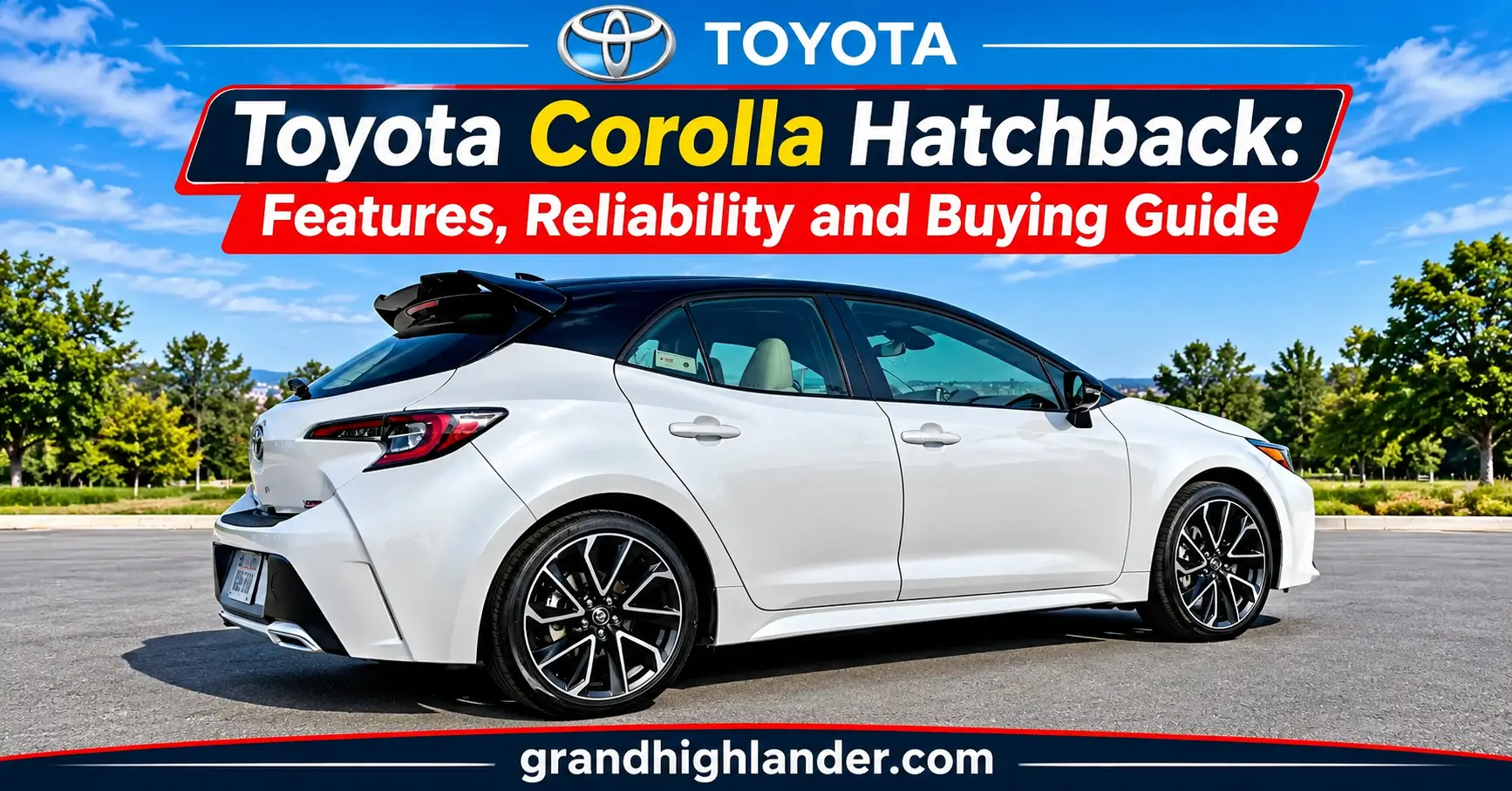
The Toyota Corolla Hatchback combines compact dimensions, sporty styling, practical technology, and everyday fuel efficiency in a five-door car. It offers a different experience from the traditional Corolla sedan, particularly for drivers who prefer a shorter body and a rear hatch for loading luggage.
However, choosing the right version requires more than comparing appearance and fuel economy. Trim levels, available features, reliability considerations, and pricing vary by model year and market. This guide covers the Toyota Corolla Hatchback’s performance, interior, available trims, common problems, and important considerations for new and used-car buyers.
What Is the Toyota Corolla Hatchback?
The Toyota Corolla Hatchback is a compact passenger car designed for everyday driving. Its five-door layout provides access to the rear seating area and cargo compartment, making it practical for commuting, shopping, and occasional road trips.
Unlike the Corolla sedan, which has a separate trunk, the hatchback has a rear door that opens upward. This arrangement makes loading certain items easier, although the car’s compact cargo area limits how much luggage it can carry.
The hatchback is also distinct from the performance-focused GR Corolla. Although both share the Corolla name, they serve different purposes. The standard hatchback prioritizes everyday usability, while the GR Corolla emphasizes high performance.
Toyota Corolla Hatchback Engine and Performance
The U.S.-market 2026 Toyota Corolla Hatchback uses a 2.0-liter four-cylinder gasoline engine producing 169 horsepower and 151 lb-ft of torque. It pairs this engine with a continuously variable transmission designed to balance responsive acceleration with fuel efficiency. A manual transmission was available on certain earlier model years.
Toyota offers three drive modes: Normal, Eco, and Sport. Normal mode suits everyday driving, Eco adjusts throttle response to encourage efficient driving, and Sport provides a sharper response.
The hatchback’s relatively compact size also helps when navigating crowded streets and parking in smaller spaces.
For drivers who want a practical commuter rather than a powerful sports car, the standard Corolla Hatchback offers a sensible balance of performance and efficiency.
Toyota Corolla Hatchback Fuel Economy
Fuel economy is one of the car’s main advantages. According to U.S. EPA estimates for the 2026 model, the SE achieves approximately 32 mpg in the city and 41 mpg on the highway. The FX and XSE are rated at approximately 30 mpg city and 38 mpg highway.
Actual fuel consumption depends on traffic, driving style, weather, maintenance, and road conditions.
| 2026 U.S. trim | City MPG | Highway MPG |
|---|---|---|
| SE | 32 | 41 |
| FX | 30 | 38 |
| XSE | 30 | 38 |
These figures are U.S. estimates and should not be applied directly to imported vehicles with different specifications.
Is There a Toyota Corolla Hatchback Hybrid?
Buyers should distinguish the standard Corolla Hatchback from hybrid versions of the broader Corolla lineup.
The U.S.-market 2026 Corolla Hatchback is gasoline-powered. Hybrid availability depends on the specific Corolla model and market, so an imported vehicle advertised as a Toyota Corolla Hatchback Hybrid deserves careful verification.
Before buying an imported car, check its chassis identification, engine specifications, registration documents, and original market designation. Do not assume that a hybrid badge or seller’s description confirms the vehicle’s factory configuration.
Toyota Corolla Hatchback Trims: SE, FX, XSE and LE
Trim names and equipment vary by model year and country. For the U.S. market, the 2026 Corolla Hatchback is available in SE, FX, and XSE configurations.
Toyota Corolla Hatchback SE
The SE is the entry-level trim. It provides the core driving experience without requiring buyers to pay for every available convenience feature.
For the 2026 U.S. model, highlights include 16-inch alloy wheels, wireless Apple CarPlay and Android Auto compatibility, and blind-spot monitoring with rear cross-traffic alert.
It is worth considering for drivers who want a relatively affordable new hatchback with useful everyday technology.
Toyota Corolla Hatchback FX
The FX adds distinctive styling, including 18-inch white-finished alloy wheels, a black rear sport wing, and sport-oriented interior details.
It may appeal to buyers who want a more distinctive appearance without stepping up to the GR Corolla’s performance-focused design.
Toyota Corolla Hatchback XSE
The XSE adds premium features and a more upscale appearance. Depending on model year, equipment can include larger wheels, enhanced interior materials, additional technology, and upgraded convenience features.
For the 2026 U.S. model, the XSE includes 18-inch graphite-colored alloy wheels and a JBL premium audio system.
What About the Corolla Hatchback LE?
The LE designation is associated with other Corolla configurations and should not automatically be treated as a Corolla Hatchback trim. Buyers researching an LE should verify whether the listing describes a sedan, another Corolla variant, or a vehicle sold in a different market.
Toyota Corolla Hatchback Interior and Practicality
The Corolla Hatchback’s interior is designed around straightforward controls, supportive front seating, and convenient connectivity.
Depending on trim and model year, equipment can include an infotainment touchscreen, smartphone integration, a digital instrument display, and automatic climate control.
The front seats generally provide a comfortable position for everyday commuting. The rear seats, however, are less accommodating for taller adults than those in some larger compact cars.
Cargo space is another consideration. The hatch opening makes it easier to load certain objects than a conventional sedan trunk, and folding the rear seats creates additional room for larger items.
Nevertheless, the Corolla Hatchback is not a substitute for a spacious family SUV. Buyers who regularly carry several passengers and substantial luggage should compare its interior dimensions with their actual needs.
Toyota Corolla Hatchback Reliability and Common Problems
The Corolla name has a strong reputation for dependable transportation, but reliability depends on maintenance, vehicle condition, and the specific model year.
A used Corolla Hatchback should be inspected rather than purchased solely on the strength of its reputation.
Corolla Hatchback Issues in 2021 and 2022 Models
When evaluating a 2021 or 2022 Corolla Hatchback, pay attention to the following areas during an inspection:
- Transmission operation: Check for unusual vibration, hesitation, warning lights, or inconsistent acceleration during a road test.
- Engine warnings: Investigate any check-engine light, coolant warning, or maintenance message before purchasing.
- Infotainment system: Test the touchscreen, backup camera, Bluetooth connection, and smartphone integration.
- Braking performance: Confirm that the brakes respond consistently and that no warning lights remain illuminated.
- Maintenance history: Review service records and investigate gaps in scheduled maintenance.
These are inspection priorities, not proof that every vehicle from these model years suffers from the same defects.
Which Toyota Corolla Hatchback Years Should You Avoid?
There is no sound basis for declaring an entire model year unsuitable without examining documented defects, recall information, and the condition of individual vehicles.
A well-maintained older Corolla Hatchback may be a better purchase than a newer example with accident damage, poor servicing, or unresolved mechanical problems.
Before buying, check the vehicle identification number for outstanding safety recalls and have an independent mechanic inspect the car. In the United States, recall information can be checked using the vehicle identification number.
For imported vehicles, also verify the original market, accident history, mileage records, and availability of replacement parts.
Toyota Corolla Hatchback 2026 vs. 2027
The 2026 and 2027 U.S.-market models share the standard 2.0-liter gasoline-engine configuration, but their trim offerings and equipment should be compared separately.
| Feature | 2026 model | 2027 model |
|---|---|---|
| Engine | 2.0-liter four-cylinder gasoline | 2.0-liter four-cylinder gasoline |
| Available trims | SE, FX, XSE | SE, XSE |
| SE estimated city/highway MPG | 32/41 | 32/41 |
| XSE estimated city/highway MPG | 30/38 | 30/38 |
| Main consideration | Choice of three trims | Updated model-year pricing and equipment |
Specifications reflect published U.S. model information. Confirm the equipment and pricing of the exact vehicle before making a purchase.
The 2027 model may suit buyers who prefer a newer vehicle, while a discounted 2026 model could offer better value. The best choice depends on the final purchase price, available equipment, warranty coverage, and financing terms.
Toyota Corolla Hatchback Price and Availability
The Toyota Corolla Hatchback’s price depends on its model year, trim, mileage, condition, and location.
In the United States, the published starting MSRP for the 2026 SE was $24,580, while the 2027 SE starts at $24,780. These are U.S. manufacturer-suggested prices, not universal prices or guaranteed dealership transaction prices.
In Pakistan, imported Corolla Hatchbacks may have substantially different costs because of import duties, exchange rates, registration expenses, and the vehicle’s original market.
When comparing cars for sale, consider the complete cost of ownership rather than the advertised price alone. Maintenance, insurance, fuel consumption, parts availability, and any necessary repairs can make a meaningful difference.
Related to: 2026 Toyota Corolla XSE: Price, Specs, Features, and Sedan vs. Hatchback
Conclusion
The Toyota Corolla Hatchback is worth considering if you want a compact car with sporty styling, practical technology, and competitive fuel economy.
Its main compromises are limited cargo capacity, less generous rear-seat space than some larger vehicles, and a trim lineup that varies by market.
For used-car buyers, condition and maintenance history matter more than simply choosing the newest model year within a budget. A careful inspection and a review of recall records can help reduce the risk of unexpected expenses.
The best Corolla Hatchback is the one that fits your daily driving needs, offers the equipment you actually use, and has a documented maintenance history.
FAQs
Is the Toyota Corolla Hatchback a good car to buy?
Yes, it can be a good choice for commuters and small households seeking a compact, fuel-efficient car. Its limited cargo space and rear-seat room may be drawbacks for buyers who regularly carry several passengers.
What is the price of a Toyota Corolla Hatchback in Pakistan?
There is no single price for every Corolla Hatchback in Pakistan. The cost depends on the imported model year, trim, condition, import status, and local market conditions. Check current listings and verify the vehicle’s specifications before buying.
What is the best year for a Toyota Corolla Hatchback?
The best year depends on your budget, desired features, maintenance history, and the condition of the specific vehicle. Compare documented reliability information and recall records instead of relying on a blanket model-year recommendation.
Is a Toyota Corolla a hatchback?
The Corolla name covers several body styles. The Corolla Hatchback has a rear liftgate, while the traditional Corolla sedan has a separate trunk. Their specifications and available trims can differ.
What is the difference between a Corolla and a Corolla Hatchback?
The standard Corolla sedan offers a conventional three-box design, while the hatchback has a shorter body and an upward-opening rear door. The hatchback can make loading certain items easier, but its cargo capacity and rear-seat dimensions differ from those of the sedan.
Should I buy a hatchback or a sedan?
Choose a hatchback if you value a compact exterior and the flexibility of a rear liftgate. A sedan may be preferable if you want a conventional trunk or prefer its styling. Compare passenger space, luggage capacity, price, and fuel economy before deciding.
What are common problems with Toyota Corolla Hatchbacks?
Potential inspection concerns include transmission irregularities, engine warning lights, infotainment faults, braking issues, and incomplete maintenance records. These are areas to investigate rather than defects that affect every car.
Is the Toyota Corolla Hatchback reliable?
It can provide dependable transportation when properly maintained. However, reliability varies with vehicle condition, servicing, driving history, and model-specific issues. A pre-purchase inspection is particularly important for used examples.
Is the Toyota Corolla Hatchback Hybrid available?
Availability depends on the market and exact vehicle configuration. The U.S.-market 2026 and 2027 Corolla Hatchbacks use gasoline engines. Verify the original specifications of any imported vehicle advertised as a hybrid hatchback.
Is the Toyota Corolla Hatchback XSE better than the SE?
The XSE offers additional features and styling upgrades, while the SE emphasizes value. The better choice depends on the price difference and whether you will use the extra equipment.



Leave a Reply